
The Prado home return program, led by Health Insurance, organizes the transition between hospital and home for patients whose hospitalization is no longer deemed necessary. Launched in 2010 for maternity discharges, this system now covers several areas: surgery, chronic conditions, and geriatrics. Its principle is based on the intervention of a Health Insurance advisor directly in the healthcare facility, before the patient’s discharge.
Prado Eligibility Criteria: The Medical Team Decides First
Access to the program does not depend on a simple request from the patient. It is the hospital medical team that declares eligibility by cross-referencing three types of criteria: health status, degree of autonomy, and the patient’s social context.
An isolated patient, without a caregiver at home and presenting complex care needs, may be directed to another solution (such as follow-up care and rehabilitation). Conversely, an autonomous person whose post-operative follow-up can be managed in the community will be proposed for Prado.
To better understand the Prado service of the CPAM and its access conditions according to each area, it is necessary to distinguish the pathways by type of hospital stay.
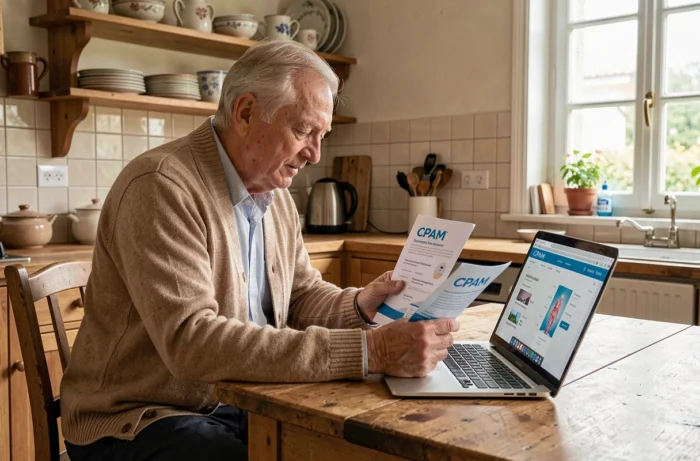
Prado Areas: Surgery, Maternity, and Chronic Diseases
The system does not operate uniformly. Each area has its own inclusion rules and involves different healthcare professionals.
- Maternity: mothers leaving the maternity ward can benefit from follow-up by a midwife at home. Postnatal packages (SF16.5 / SF12) are provided up to the twelfth day after delivery, covered under the mother’s rights.
- Surgery: initially limited to orthopedics in 2012, the surgical aspect was generalized to all interventions in 2016. A liberal nurse or physiotherapist provides follow-up depending on the nature of the operation.
- Heart Failure: patients in advanced stages (NYHA III and IV) benefit from a structured protocol of home nursing sessions, one per week for two months, then one every two weeks for four months, for a maximum of fifteen sessions billed at AMI 5.8.
- COPD (chronic obstructive pulmonary disease): offered since 2015 to patients hospitalized for an exacerbation, this pathway includes coordinated respiratory follow-up with the treating physician.
- Stroke and TIA: patients hospitalized for a stroke or transient ischemic attack can also be included, with multidisciplinary care at home.
The geriatric aspect adds a nuance rarely mentioned. Patients aged 75 and older are eligible regardless of the cause of hospitalization, and not just within the areas listed above. This age-based approach expands the scope of the program for elderly individuals.
Heart Failure Protocol: Structured Nursing Follow-Up
The heart failure Prado pathway deserves special attention because it illustrates the level of structuring of the program. The liberal nurse involved must have undergone specific training in heart failure monitoring.
Each session includes weight measurement, blood pressure monitoring, assessment of decompensation signs (edema, shortness of breath), and a review of treatment adherence. A report must be sent to the treating physician within 48 hours following each visit.
This protocol does not limit itself to passive monitoring. The nurse participates in the patient’s therapeutic education: recognizing warning signals, managing a low-sodium diet, and adapting physical activity. The AMI 5.8 billing per session incorporates this educational dimension, provided that the rules for billing accumulation are respected.
Concrete Process of Returning Home with Prado
The process begins during hospitalization, not after. A Health Insurance advisor visits the patient’s bedside to present the program and obtain their consent. The patient remains free to refuse.
If the patient agrees, the advisor contacts the healthcare professionals chosen by the patient (treating physician, nurse, midwife, physiotherapist). An initial appointment is organized in the days following discharge, sometimes as soon as the next day.
The treating physician receives a notification and the necessary elements from the hospital record for continuity of care. This coordination aims to avoid gaps in care, particularly early readmissions related to insufficient follow-up in the initial days.
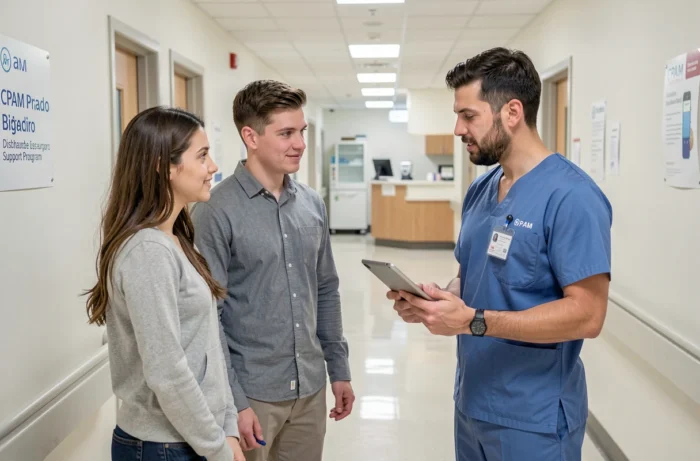
Establishments Participating in the Prado Program
The deployment of Prado remains gradual. Not all healthcare facilities offer this service yet. Coverage depends on agreements signed between hospitals, clinics, and local primary health insurance funds.
To find out if a facility participates in the program, the most direct approach is to ask the healthcare team during hospitalization. The hospital’s social service or the nursing supervisor can confirm the availability of the program.
The program concerns both insured individuals under the general scheme and those under certain special schemes. Enim (seafarers) and CRPCEN (notary clerks) have integrated Prado for their affiliates and dependents over 18 years old.
The free service for the patient is an important point to note. Prado incurs no additional cost: the home care provided is covered under the usual Health Insurance framework, with the application of third-party payment when the healthcare professional practices it. The program does not replace home hospitalization (HAD), which addresses more serious medical situations, but it fills the gap between hospital discharge and the resumption of autonomous community follow-up.