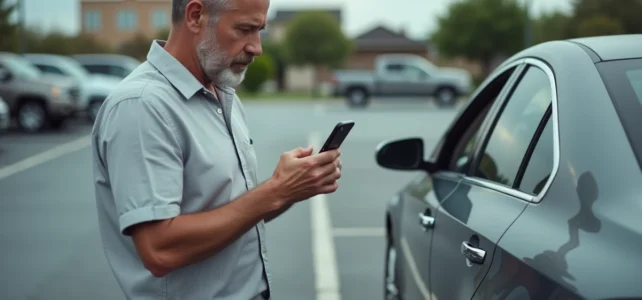
After a collision in a parking lot or a windshield break, the mechanic’s bill arrives. Your insurer informs you that part of the cost is your responsibility. This amount, the deductible, often comes as a surprise because it varies depending on the contract, the type of claim, and your level of responsibility. Understanding who pays what can help avoid a budget shortfall at the worst moment.
Loaning your car and undeclared driver: the trap hidden in the contract
You lent your car to a friend for the weekend. They cause a collision. Who pays the deductible in this case? It all depends on what your car insurance contract stipulates.
If the driver is not declared on the contract, the insurer may apply an additional deductible, or even refuse compensation. Some general conditions provide for a fixed increase as soon as an occasional driver not listed takes the wheel. Other contracts completely exclude coverage.
Before handing over your keys, check the “loaning your car” clause in your specific conditions. If your insurer requires prior notification, a simple call or message through the client area is usually sufficient. A comprehensive guide on deductibles in the event of a car claim details the situations where this increase applies, including for rental vehicles.
The case of rentals is, by the way, distinct: the rental contract specifies its own contractual deductible, often higher than that of a personal insurance. The deductible buyback option offered at the rental counter then covers this specific remaining charge.

Absolute or relative deductible: the difference changes everything about your remaining charge
Two types of deductibles coexist in car contracts, and their functioning is completely different.
The absolute (or fixed) deductible is the most common. The insurer deducts a predefined amount from each compensation. If your deductible is 150 euros and the repair costs 600 euros, you receive 450 euros. The calculation does not change, regardless of the total.
The relative (or simple) deductible works like a threshold. If the damages exceed this threshold, the insurer reimburses the full amount. If the damages remain below, you receive nothing. For example, with a relative deductible of 150 euros:
- Repair of 120 euros: no compensation, the deductible is not reached.
- Repair of 200 euros: full compensation of 200 euros, as the amount exceeds the threshold.
- Repair of exactly 150 euros: no compensation either, the threshold is not crossed.
The relative deductible benefits the insured for medium to high claims. However, it leaves you responsible for all minor damages. Read carefully the mention “absolute deductible” or “relative deductible” in your personal conditions: this single line determines whether you will be reimbursed or not for a minor claim.
Responsibility and identified third party: who covers the deductible depending on the claim
The level of responsibility in the accident directly affects the application of the deductible. Three situations arise.
When you are 100% responsible for the claim, the deductible applies in full. Your insurer compensates the damages of the other party (if you have liability coverage) and deducts the deductible from your own repairs (if you have damage or all-risk coverage).
When responsibility is shared, the deductible applies proportionally. At 50/50, you bear half of the deductible specified in the contract.
When you are not responsible and the third party is identified, you do not pay a deductible. The third party’s insurer reimburses all repairs through the agreement between insurers. However, if the third party flees or remains unidentified (vandalism, hit and run), your own insurer applies the deductible from your contract, even if you committed no fault.
This last situation often generates the most frustration. Filling out a precise amicable report with as many details as possible (witnesses, photos, license plate of the other vehicle) remains the best reflex to avoid bearing the deductible alone.
Deductible buyback and CatNat surcharge: anticipating the real cost of a claim in 2025
Several levers allow you to reduce or eliminate the deductible before a claim occurs.
Car deductible buyback option
The deductible buyback is a paid option offered by most insurers. In exchange for an increase in your annual premium, the insurer commits to not applying a deductible in the event of a claim. This option is cost-effective if you drive a lot or if your vehicle is parked in a high-risk area (theft, hail).
The calculation to be made is simple: compare the annual additional cost of the buyback to the amount of the deductible you would have to pay in the event of a claim. If the annual additional cost exceeds the expected deductible, the buyback is not cost-effective.
Increase in the natural disaster surcharge
The surcharge applied to car contracts to cover natural disasters has increased from 6% to 9% as of January 1, 2025. This increase raises the overall premium without changing the amount of the deductible itself.
At the same time, car insurance rates continue to rise, with a projected increase of 4 to 6% in 2026 according to market players. Anticipating the deductible is therefore no longer enough: you must also factor in the premium increase when renewing.
- Review your specific conditions to identify the type of deductible (absolute or relative) and its amount per coverage.
- Check the “undeclared driver” clause if you regularly lend your vehicle.
- Compare the cost of the deductible buyback to the actual amount of the deductible on each coverage (glass breakage, theft, all accident damage).
- Always keep photos and testimonies after a claim to facilitate the identification of the responsible third party.

The deductible remains a balancing mechanism between premium and remaining charge. Choosing a high deductible reduces the monthly premium but exposes you to an unexpected expense on the day of the claim. The right balance depends on your available budget in case of unforeseen events and your actual exposure to risk, not a universal rule.