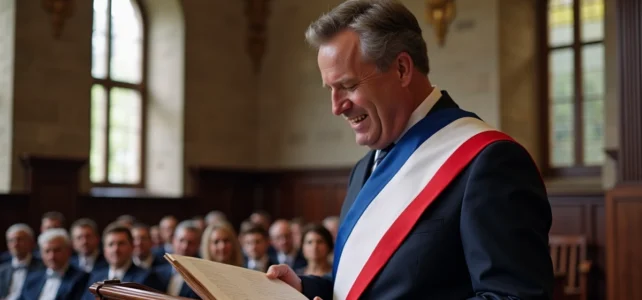
The reading of the marriage certificate during the civil ceremony cannot be entrusted to just anyone. The Civil Code strictly regulates this formality, and the ministerial response from 2013 to Senator Jean-Noël Cardoux has clarified: the reading of the marriage certificate cannot be delegated to a municipal official. Only the civil registrar is authorized to perform it.
Distinction between reading articles of the Civil Code and reading the marriage certificate
The civil ceremony includes two distinct readings that are often confused, even by experienced local officials. Article 75 of the Civil Code requires the civil registrar to read certain articles related to the rights and duties of spouses before the exchange of consents. Article 38 of the same code provides for the reading of the marriage certificate to the parties involved after the exchange of consents.
These two readings follow the same principle: they fall under the exclusive competence of the civil registrar. The Ministry of the Interior, in its response published in September 2013, confirmed that neither the reading of the articles nor that of the certificate can be delegated to a mere local official, even if they usually assist the mayor during the ceremonies.
To delve deeper into the practical modalities governing the reading of the marriage certificate on Espace Mariage, one must start from this strict legal basis before considering real adjustments.
Civil registrar: who can celebrate a marriage and read the certificate
The civil registrar is, in principle, the mayor of the municipality. The deputy mayors have full rights as civil registrars and can therefore celebrate a marriage and read the certificate without any additional formalities.

Beyond the mayor and their deputies, a municipal councilor can receive a delegation of civil registrar functions by order of the mayor. This delegation must be formalized and specify the acts concerned. Without this order, a municipal councilor cannot celebrate the marriage or proceed with the reading of the certificate.
We recommend systematically checking the existence and validity of this order. A marriage celebrated by a person lacking the status of a civil registrar can be challenged in court, which poses a real risk to the validity of the union.
Case of small municipalities
In small municipalities, this question arises regularly. The town clerk, even if they prepare the entire file and draft the certificate, does not have the authority to read it during the ceremony. This rule applies without exception, regardless of the number of inhabitants in the municipality.
If the mayor and all deputies are unavailable, the solution is to delegate to a municipal councilor. In extreme cases (such as a last-minute marriage), specific procedures exist, but the requirement for a competent civil registrar remains.
Delegation of the reading of the marriage certificate: what is allowed and what is not
The confusion often arises from the visible role that certain municipal officials play during the ceremonies. In practice, the town clerk can manage logistics, guide the couple, and prepare documents. These interventions pertain to material organization, not the legal conduct of the ceremony.
Here are the rules governing the reading of the certificate:
- The mayor, as the civil registrar by law, is competent to read the certificate without any particular condition.
- The deputy mayors have the same competence by right, without the need for a specific order for the reading.
- A municipal councilor must have a formal delegation by order of the mayor to perform the functions of a civil registrar.
- A local official (town clerk, administrative agent) cannot under any circumstances read the certificate, even in the presence of the mayor.
The response from the Ministry of Justice, published in May 2014 in response to Senator Éric Doligé’s question, confirmed this position in identical terms: no delegation of the reading is possible to a non-civil registrar agent.
Official reading and interventions by relatives: two distinct phases of the ceremony
One point that competing articles rarely address concerns the boundary between the legally binding part of the ceremony and the symbolic moments that many municipalities now allow.
The witnesses or relatives of the couple cannot read any part of the official certificate. Their intervention takes place in a distinct time, dedicated to readings of texts, poems, or personal speeches. These moments have no legal value and do not replace the obligations of the civil registrar.
This dissociation is clear in law but sometimes blurred in the staging of the ceremony. Some mayors willingly allow relatives to intervene between the reading of the articles of the Civil Code and the signing, creating the impression of a participatory ceremony. The official part (reading of the articles, collection of consents, reading of the certificate) remains under the exclusive responsibility of the registrar.
Practical consequences for future spouses
If you wish to personalize your ceremony at the town hall, contact the civil status service of your municipality in advance. Most town halls accept readings of texts by relatives, provided they do not intersperse the official sequence.
The reading of the marriage certificate remains one of the few administrative acts where delegation is so strictly regulated. This rigor protects the validity of the union and ensures that the civil registrar personally assumes responsibility for each mention made in the certificate. Before assigning a role to a relative or municipal agent during the ceremony, ensuring that the boundary between symbolic solemnity and legal formality remains clear avoids any subsequent disputes.