
Each box of medication sold in pharmacies carries a unique number, printed beneath the barcode. This number is the CIP code. It identifies not the molecule itself, but a specific presentation: a dosage, a galenic form, and a given packaging. Understanding its purpose and where to find it can save time during dispensing, reimbursement, or simple verification.
The CIP-UCD coupling, a mechanism not explained in the leaflets
You may have noticed that your pharmacist handles two different types of codes depending on whether they are dispensing a whole box or a few individual tablets. The first is the CIP code. The second is the UCD code (Common Dispensing Unit).
The CIP code identifies the commercial packaging as it comes from the factory. The UCD code, on the other hand, designates the smallest unit of intake (a tablet, an ampoule, a dose). The Digital Health Agency (ANS) maintains a reference that links each CIP code to the corresponding UCD codes. This reference is integrated into the Multi-Terminal Server, used by prescription and dispensing software in both community pharmacies and hospitals.
In practice, when a hospital pharmacist prepares an injectable bag, their software automatically converts the CIP code from the box into UCD units to calculate the dosage and bill for the act. Without this correspondence, everything would have to be recalculated manually. To better understand the CIP code in pharmacies, it is essential to grasp this pivotal role between industrial packaging and the unit actually administered to the patient.
This CIP-UCD coupling also serves for the traceability of sales. The data transmitted by pharmacies and healthcare establishments use these two codes to track the flow of medications in the French market.
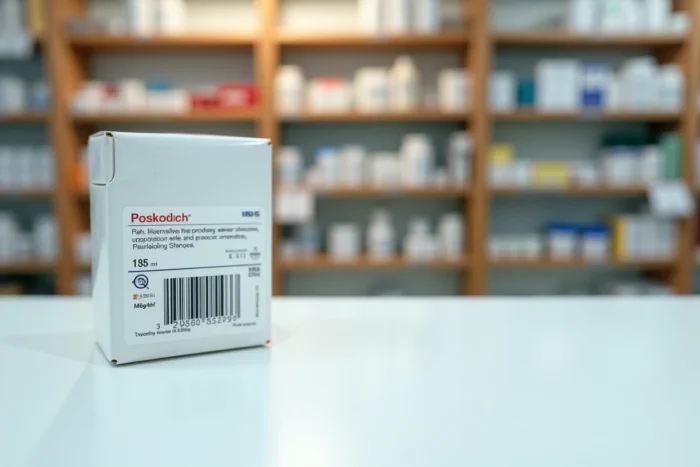
Where to find the CIP code on a box of medication
The CIP code is located in a specific place on each packaging. Spotting the barcode is the most straightforward method.
On the physical packaging
Turn the box over. Beneath the barcode, a series of numbers is printed. The CIP13 consists of exactly 13 digits and starts with the prefix 3400. This prefix identifies health products registered in France. Some older packages still display a 7-digit code (CIP7), but it is gradually being replaced by the 13-digit format.
On a prescription or a reimbursement statement
Your health insurance statement often mentions the CIP code next to the name of the medication. Prescription software automatically incorporates it when the doctor selects a specialty. If you are looking to verify a specific medication, this number allows you to eliminate any ambiguity between two dosages or two box sizes.
In online databases
Several digital tools provide access to CIP codes:
- The public database of medications (BDPM), managed by the Ministry of Health, displays for each specialty one or more CIP codes corresponding to the different available packaging.
- The health insurance database (BDM) allows searching for a product by its CIP code or by its name, along with the associated reimbursement information.
- The CIP databases (Club Inter Pharmaceutique) serve as a reference for the entire pharmaceutical distribution chain, from laboratories to pharmacies.
The quickest way remains the BDPM: a search by specialty name immediately displays the CIP codes for each marketed presentation.
CIP code and medication traceability: what it changes in practice
The CIP code is not only used to identify a product on the shelf. It is the foundational block of the French pharmaceutical traceability system, supervised by the ANSM.
Every stock movement, from the factory to the patient, is recorded via the CIP code. When a wholesaler delivers to a pharmacy, the transaction is tracked by this number. When the pharmacy records a sale, the CIP code is sent back into the health data systems. This chain allows tracking the volumes of dispensing by presentation, geographical area, and period.
In the event of a batch recall, the ANSM uses the CIP code coupled with the batch number to precisely target the affected boxes. Without this system, all boxes of a specialty would need to be recalled, including those from non-defective batches.
Traceability by CIP code also informs public health decisions. The aggregated sales data from pharmacies, identified by CIP code, are used to monitor trends in medication consumption and detect unusual signals (such as a sudden increase in the dispensing of an antibiotic in a region, for example).

CIP7, CIP13, and ACL code: do not confuse
Three codes still coexist on some products sold in pharmacies. Their confusion is common, especially for parapharmaceutical products.
- The CIP7 is the old 7-digit format. It remains readable on older boxes or in some outdated software, but the CIP13 has replaced it as the standard.
- The CIP13 is the current 13-digit format (prefix 3400). It applies to medications that have a marketing authorization (AMM) issued by the ANSM.
- The ACL code (Logistics Coding Association) identifies health products sold in pharmacies that are not medications: medical devices, dietary supplements, cosmetics. It shares the same prefix 3400 and the same 13-digit format, which can sometimes lead to confusion.
Are you trying to determine whether a product is a medication or a dietary supplement? Check if the code corresponds to a record in the BDPM. If the product is not listed there, it is likely an ACL code, and the product does not have medication status.
The CIP code remains the reference identifier for any product with an AMM in France. Its presence on a box guarantees that the medication is registered in the official distribution circuit, from manufacturing to dispensing in a pharmacy or healthcare establishment.