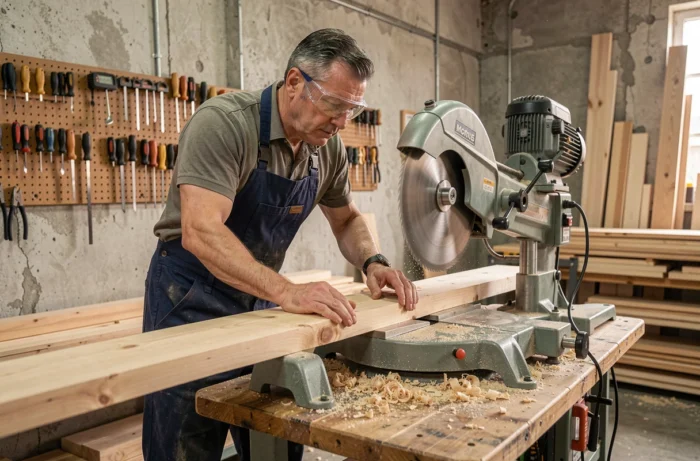
The radial saw holds a unique place in cutting tools. Unlike a traditional miter saw, it features a sliding carriage that moves the blade back and forth, increasing the cutting width on thick or bulky pieces. Comparing available models requires going beyond product sheets and examining what the advertised features mean in real working conditions.
Actual cutting capacity of a radial saw: what technical sheets don’t show
The maximum cutting width displayed by a manufacturer almost always corresponds to a straight cut, with the blade perpendicular to the table. As soon as the base pivots to make a bevel cut, this width can sometimes decrease significantly.
A model advertised for wide pieces in a straight cut may be limited on a 45° cut, to the point of no longer accommodating certain tall baseboards or crown moldings. Comparing capacities at different angles reveals the true differences between models.
Before consulting which comparison for a radial saw to consider, it is worth noting the dimensions of the pieces you cut most often, then checking if the targeted model accepts them well at both 45° and 90°. This data, rarely highlighted, makes the difference between a suitable tool and a frustrating one.
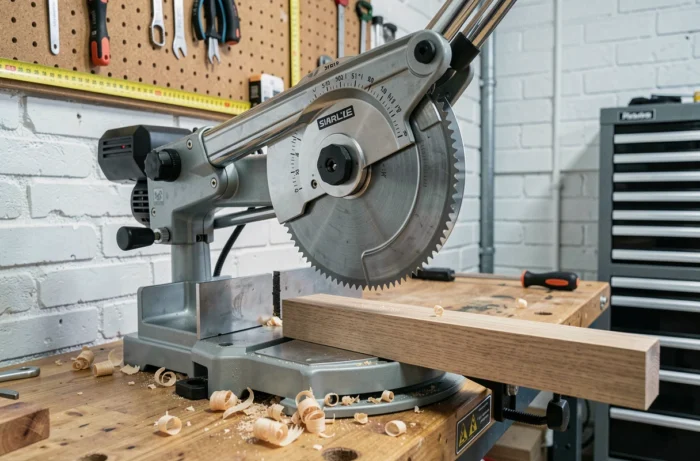
Wood dust extraction: a health criterion, not a comfort one
Most comparisons mention the presence of a chip bag as an advantage. This is insufficient. Wood dust is classified as carcinogenic under French regulatory standards. For regular use, connecting to a site vacuum with extraction as close to the source as possible is not a luxury; it is a health precaution.
Requirements differ depending on the context. A homeowner using their radial saw a few hours a month in an open garage does not face the same risk as a carpenter in a closed workshop. For a professional workshop with employees, recommendations include regular maintenance of the extraction system and periodic ventilation checks.
What this changes at the time of choice: check the diameter of the machine’s dust extraction port and its compatibility with your vacuum. Some models offer a port that is too narrow for professional vacuums, which reduces extraction flow and leaves some fine dust suspended.
Blade, power, and materials: the three parameters that determine cutting
The diameter of the blade determines the maximum cutting depth. Two formats dominate the consumer and semi-professional market. The most common is suitable for standard carpentry work (baseboards, paneling, battens). The larger format accommodates thicker pieces, useful for light framing or cladding.
Motor power and type of materials
The power advertised in watts gives an indication, but it says nothing about the actual torque at low speed. A powerful motor that loses torque when cutting hard wood (oak, beech) will produce burns on the edge and wear the blade prematurely. The type of wood being worked determines the choice of motor as much as the raw power.
For composite materials or aluminum, the tooth design of the blade matters more than power. A blade with a high number of teeth and a geometry suited for non-ferrous metals provides clean cuts without burrs. Using the wood blade supplied with the saw on aluminum damages the blade and compromises safety.
- Check the machine’s compatibility with specialized replacement blades (fine tooth for aluminum, alternate tooth for solid wood).
- Ensure that the blade bore matches the model, as a poorly centered adapter causes vibrations and loss of precision.
- Opt for a tool-free blade change system if you frequently switch between materials.
Laser guiding system and cutting precision: gadget or true reference
The guiding laser projects a light line onto the piece to indicate the cutting line. On paper, this is an advantage. In practice, reliability varies greatly from one model to another.
A poorly calibrated factory laser leads to repeated errors on each cut. Some manufacturers allow user recalibration, while others do not. Before paying extra for this feature, it’s essential to know if the adjustment is accessible and reproducible.
The alternative to the laser remains a pencil line and good workshop lighting. For repetitive cuts (a batch of identical baseboards), an adjustable length stop provides a consistency that the laser alone cannot guarantee. The length stop is often more useful than the laser for series.
Overall precision: play in the carriage and rotating table
The sliding carriage of a radial saw introduces a mechanical weak point. On entry-level models, lateral play in the slides results in a slight offset at the end of the stroke. This defect, sometimes imperceptible on softwood, becomes visible on tight joint assemblies.
Test the carriage empty before purchase if possible. A smooth movement, without hard spots or noticeable play, indicates correct guiding quality. The rotating table should also lock firmly at common angles (0°, 15°, 22.5°, 45°) with positive indexing.
Radial saw for homeowners or for professional workshops: two purchasing logics
A DIYer who installs flooring or baseboards once a year does not need the same tool as a craftsman who cuts wood eight hours a day. The weight of the machine, the robustness of the chassis, and the availability of spare parts clearly separate the ranges.
For occasional use, a compact and lightweight model makes storage and transport easier. For a fixed workshop, the weight of the chassis contributes to stability and reduces vibrations, improving cutting quality over time.
- Occasional use (home DIY): prioritize compactness, lightweight, and an accessible price, even if it means accepting a less rigid carriage.
- Regular use (renovation, finishing work): target a carriage with solid bearings, a motor with torque, and a dust extraction port compatible with a site vacuum.
- Daily professional use: demand a thick cast iron or aluminum chassis, spare parts available for several years, and a quick clamping system for the piece.
The price of a radial saw is not limited to the purchase cost. Replacement blades, compatible vacuum, and accessories (stop, extension support) increase the total budget. Incorporating these peripheral costs from the start avoids unpleasant surprises and guides towards a choice more consistent with the actual use of the machine.