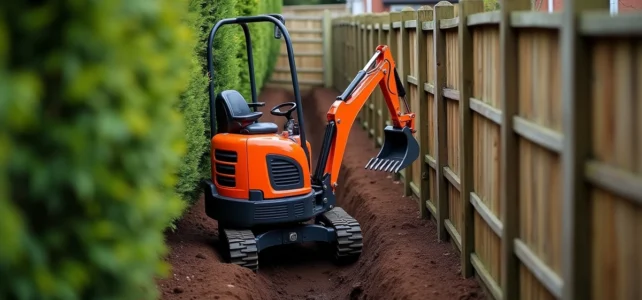
The width of a mini excavator directly determines its ability to operate in a residential garden. On an open construction site, this question barely arises. On a private plot, between a shared fence and a shrub bed, every centimeter counts, and the choice of machine often hinges on the overall width of the tracks.
Retractable tracks and variable width: the parameter that technical specifications hide
Most catalogs indicate a single width for a given mini excavator. This value generally corresponds to the deployed width, meaning the working position of the tracks. It does not reflect the actual minimum width in transport or narrow passage configuration.
Recent machines weighing less than two tons increasingly incorporate a system of retractable tracks with variable width. The principle: the pads slide hydraulically inward toward the chassis, reducing the overall width by several centimeters without disassembling anything. The Univert/Melain Motoculture 2026-2027 catalog, for example, lists the mini excavator 18V5 with a width range from 990 mm in retracted mode to 1,300 mm in deployed mode.
Some rental companies also offer machines with retractable tracks displaying a range of 900 to 1,200 mm, intended for light earthworks and clearing in constrained environments. We recommend systematically checking if the machine has this feature before signing a rental contract, as it transforms a “too wide” mini excavator into a machine compatible with a standard garden gate.
To delve deeper into the minimum width of a mini excavator according to the various sizes available on the market, the distinction between fixed and variable width remains the primary sorting criterion.
Mini excavator width and garden access: critical dimensions to note before renting
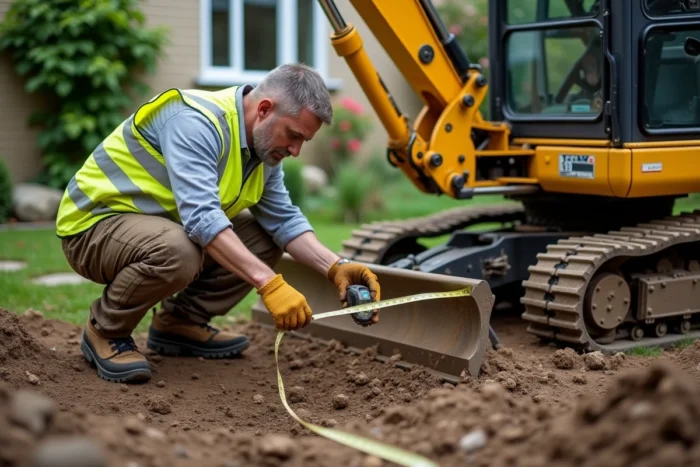
Before reserving a machine, three ground measurements must be taken with a rigid meter, not an approximate laser.
- The clear width of the gate or side passage, measured at the narrowest point (posts, protruding hinges, embedded meter). A gate advertised as 1 m useful often drops below 95 cm once obstacles are accounted for.
- The width between fixed elements in the garden along the access route: low wall, septic tank access, concrete edging, tree trunk. A mini excavator does not just need to pass; it must also pivot, and the rotation of the turret adds lateral overhang.
- The load-bearing capacity of the ground at the intended passage: a lawn soaked after a week of rain will not support a machine over one ton without deep ruts. Ground pressure depends on the contact area of the tracks, thus indirectly on their width.
Micro-excavators weighing less than one ton go below 700 mm in width. They can access almost all residential entrances, including side pedestrian passages. However, their digging depth and pulling force limit their use to shallow trenches or superficial earthworks.
Micro-excavator or 1.5-ton mini excavator: technical arbitration for gardening
Mini excavators from 2 to 5 tons dominate the rental market, as they cover the majority of professional sites. For a homeowner landscaping their garden, this offer creates a bias: rental fleets are filled with machines exceeding 1,400 mm in width, while the actual need often lies below 1,100 mm.
A micro-excavator (less than one ton) is suitable for laying a border, digging a trench for automatic irrigation, or removing a small-diameter stump. Its width, often between 700 and 900 mm, allows it to navigate through garden paths without damaging the borders or adjacent beds.
A mini excavator weighing 1 to 1.5 tons, with a width of around 990 to 1,200 mm in retracted mode, covers a broader spectrum: earthworks for a terrace, excavation several tens of centimeters deep, moving significant volumes of soil. This is the size we consider optimal for common residential gardening, provided that access is compatible.
The classic trap is to rent a more powerful machine “just in case.” On landscaped terrain, the excess weight causes collateral damage: soil compaction, crushing of shallow buried networks, ruts on the lawn. The cost of restoring the lawn and plantings quickly negates the supposed time savings.
Buckets and accessories: their impact on operational width
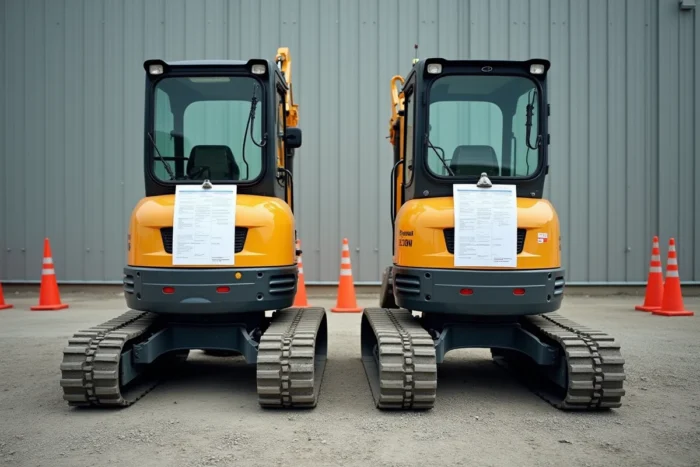
The width of the mini excavator is not limited to the measurement between tracks. The standard bucket supplied with the machine consistently exceeds the width of the chassis. A common excavation bucket on a micro-excavator measures between 400 and 600 mm, but in transport position (turret sideways), it can create a lateral overhang greater than the width of the tracks.
For fine gardening work (trench for electrical cable, conduit passage), a narrow bucket of 200 to 300 mm reduces the volume of soil moved and limits the disturbed area. We observe that many rental companies do not spontaneously offer this type of accessory: it must be requested at the time of booking.
Other accessories (auger, rock breaker, grapple) also modify the height and width footprint. On a garden site under low branches or near a pergola, the working height of the boom becomes an additional constraint to consider alongside the passage width.
Safety and regulations on gardening sites with mini excavators
Using a mini excavator in a private garden does not exempt one from the safety rules applicable to any earthworks site. Before digging, locating buried networks (water, gas, electricity, telecoms) remains mandatory, even on a residential plot. A work declaration may be necessary depending on the depth and nature of the project.
The safety perimeter around the machine must remain clear throughout the turret’s rotation area. In a garden, this concretely means that no one should be between the mini excavator and the fence, nor in the rear blind spot, including children or pets.
The width of the machine also determines the feasibility of loading onto a trailer. A mini excavator less than 1,200 mm wide can be loaded onto a standard flatbed trailer. Beyond that, a specific trailer or transportation by the rental company is required, which alters the overall budget of the project.
Choosing the right width of mini excavator for a garden is not just about comparing technical specifications. It is a balancing act between the available passage, the type of planned work, and the acceptable damage to the existing terrain. Measuring before renting remains the only reliable method to prevent a machine from getting stuck in front of the gate on the big day.