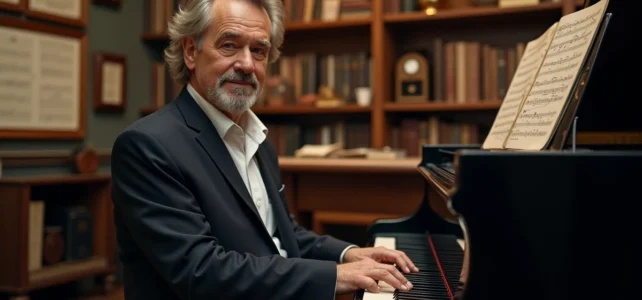
Yvan Cassar, born on December 12, 1966, is a conductor, pianist, and arranger. His career spans a wide spectrum, from classical repertoire to French variety tours with artists such as Johnny Hallyday, Mylène Farmer, and Natalie Dessay. His private life, however, remains almost entirely absent from the media.
The piano teacher at the conservatory: the starting point of a musical lineage
The notion of transmission for Yvan Cassar does not begin with a family tree. It starts with a teacher. In an interview on France Musique, Cassar stated that his piano teacher at the conservatory “changed his life.”
This phrase summarizes a precise mechanism. The musical lineage here passes through the master, not through the parent. The Paris conservatory played the role of a matrix: it is where the young pianist acquired the harmonic and orchestral tools that structure all his subsequent work.
Before the conservatory, Cassar grew up in an environment where popular dance and academic rigor coexisted. This dual background, rarely commented on in portraits dedicated to him, explains his ability to navigate between scholarly registers and broad audiences. When exploring Yvan Cassar and his family, one realizes how much this trajectory relies on musical ties rather than documented blood relations.

Yvan Cassar as an arranger: building a musical family through studio work
An arranger orchestrates the sound material of an artist. He chooses the timbres, distributes the instrumental voices, and decides on the dynamics. This role involves a lasting creative intimacy with the performer.
Cassar has held this role with artists from opposing universes. With Mylène Farmer, he designed the orchestrations for several tours at the Stade de France. With Natalie Dessay, the work focuses on the lyrical repertoire. With Johnny Hallyday, he conducted symphonic concerts whose format continues under the name “Johnny Symphonique.”
Each long collaboration creates a bond of mutual transmission. The arranger brings his harmonic culture, while the performer imposes his vocal and stage constraints. This back-and-forth, repeated over the years, forges a relationship that exceeds the contractual framework.
The dual identity of classical and variety
Most French conductors remain within a single register. Cassar refuses this separation. His work with Louis Chedid, documented by setlists from joint concerts, coexists with conducting regional operas.
This dual practice is not a compromise. It reflects a conviction: music transmits better when it circulates between audiences. A variety listener who discovers a sophisticated symphonic arrangement accesses a musical vocabulary he would not have sought on his own.
Transmission to the public: festivals and concerts as intergenerational vectors
Cassar regularly conducts in contexts that mix generations of spectators. The International Festival of Colmar, the Un Violon sur le Sable festival in Royan, and the 1001 Notes festival have included him in their programming.
These events share a characteristic: they target family audiences, not just seasoned music lovers. The outdoor format or festival setting lowers the barrier to entry for orchestral music.
- At the Un Violon sur le Sable festival, Cassar shared the stage with pianist Marco Poingt, in a format blending music and sport on clay, accessible to all ages.
- The Johnny Symphonique Tour, which he conducts, schedules dates in regional arenas (Brest, Narbonne), attracting an audience that comes for Hallyday’s repertoire and leaves with a symphonic experience.
- His interventions on cultural cruises (Ponant) place classical music in a travel context, reaching listeners who do not frequent concert halls.
The concert becomes a space for intergenerational transmission when it brings together spectators aged twenty and seventy around a common repertoire.

Yvan Cassar’s private life: why silence nurtures another form of family
No major interview documents Cassar’s marital status, any children he may have, or the organization of his domestic life. This choice of discretion, maintained over several decades, is not a void. It is a stance consistent with his practice.
By focusing his media presence on musical work (rehearsals, studios, stages), Cassar shifts the notion of family towards the professional collective. His regular collaborators form a stable constellation that ensures the continuity of his musical approach from one project to another.
The role of the mentor in the transmission chain
The chain is clear: a conservatory teacher transmits to Cassar, Cassar transmits to the musicians he conducts, and these musicians transmit to the public. Each link modifies and enriches the musical message received.
This logic of expanded musical family operates without biological ties. It relies on the time spent together in rehearsal, on the sharing of a technical vocabulary, and on the trust accumulated over productions.
Cassar’s journey, from popular dance to the Stade de France through regional operas, outlines a map where transmission does not follow a downward parent-child line. It radiates in concentric circles, from the master to the student, from the arranger to the performer, from the conductor to the public. The musical passion, for Cassar, is transmitted through shared practice, not through declared lineage.