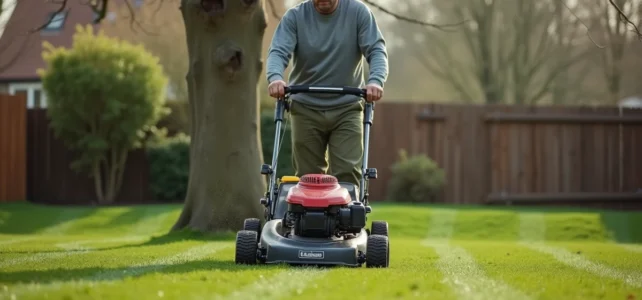
On a 2500 m² of land, the area alone no longer dictates the choice of mower. We regularly observe buyers who oversize their machine by relying solely on the number of square meters, while the configuration of the land, the slope, and the acceptable mowing time weigh just as much in the decision.
Hydrostatic transmission and slope: the criterion that area does not reveal
A perfectly flat 2500 m² plot and an identical plot with sloped areas cannot be mowed with the same machine. On a slope, a riding mower with hydrostatic transmission allows for smooth speed modulation and maintains traction on inclines. Classic mechanical transmissions (belt-driven or geared) require gear changes on slopes, which increases clutch wear and fatigues the operator.
Several manufacturers display official slope limits for their models. Ignoring these thresholds risks permanent wheel slippage and uneven cutting. We recommend measuring the actual slope before any purchase, using a simple laser level or a clinometer app on a smartphone.
To identify a suitable mower for 2500 m², one must cross-reference the area with the percentage of slope and the presence of obstacles (trees, flower beds, walls) that multiply maneuvers.
Cutting width and actual mowing time on 2500 m²
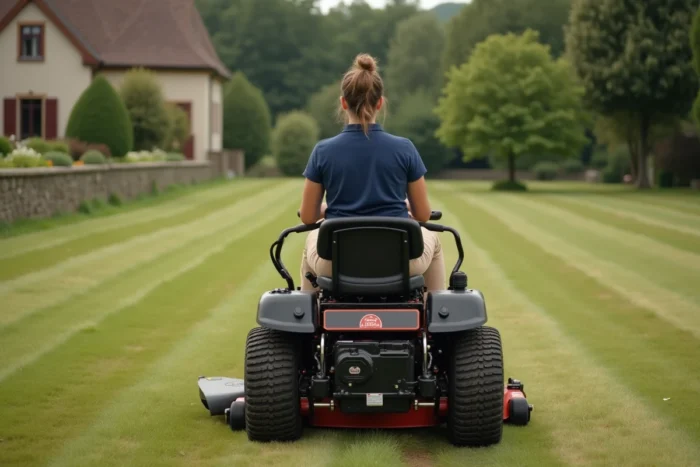
Beyond 2000 m², cutting width becomes the discriminating factor. A classic towed mower with a deck of 46 to 53 cm requires covering a considerable cumulative distance. On 2500 m², the number of back-and-forths extends mowing time by a good hour compared to a riding mower equipped with a 90 cm deck or larger.
The calculation is simple: the wider the deck, the fewer passes, and the fewer turns. Turns are precisely the most time-consuming and exhausting phase on a large plot. A wide deck also reduces soil compaction by limiting the number of wheel passes on the same strips.
Choosing between a thermal towed mower and a riding mower
A thermal towed mower with a sufficiently powerful engine can cover 2500 m², but at the cost of long mowing times and real physical fatigue. The riding mower becomes relevant as soon as mowing time exceeds one hour and thirty minutes. If the land is clear and flat, towing remains viable for those who accept the effort. If the land has sloped areas, trees to navigate around, or narrow passages, the riding mower is necessary for its maneuverability and stability.
The size of the riding mower also matters: a model that is too wide will not fit between tight flower beds. We observe that models with a short turning radius (like “zero turn”) compensate for a generous deck width with superior agility in cluttered areas.
Lawn robot for 2500 m²: actual capacity and installation constraints
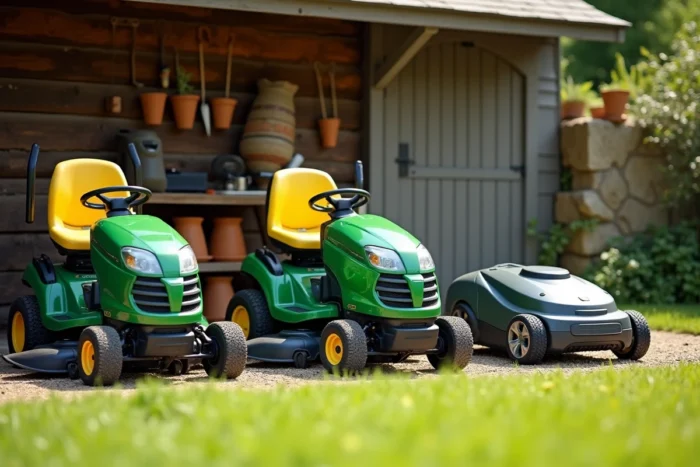
Lawn robots capable of covering 2500 m² exist, but their operation differs radically from traditional mowing. The robot mows continuously, either randomly or systematically, and maintains the grass at a constant height thanks to permanent mulching. The aesthetic result is often superior to a manual weekly mowing.
The main constraint remains the installation of the perimeter wire (or GPS/RTK configuration on recent models). For 2500 m², the perimeter to be wired and the number of islands to exclude (trees, flower beds) significantly extend the setup time. Recent models equipped with obstacle avoidance sensors reduce the need for wiring around each obstacle.
Limitations of the robot on uneven terrain
A plot with marked slopes, exposed roots, or wet areas poses challenges for the robot. Most models can handle moderate slopes, but beyond a certain threshold, the robot slips or gets stuck. On a complex 2500 m² plot, the robot is better suited as a complement to a main mower than as a standalone solution.
- Flat and clear terrain: the robot manages the 2500 m² on its own with appropriate programming
- Terrain with moderate slopes and a few obstacles: the robot works but requires careful wiring and exclusion zones
- Uneven terrain with steep slopes: the robot only covers part, a riding or towed mower remains necessary for the rest
Collector bag, mulching, or side discharge: the impact on maintenance
On 2500 m², the volume of mowing waste becomes a real logistical issue. A standard collector bag fills quickly, requiring multiple stops to empty it. Mulching eliminates this problem by finely shredding the grass and redepositing it on the ground as natural fertilizer. This technique works well as long as mowing is done regularly (every five to seven days) to keep the blades short.
Side discharge, common on riding mowers, throws the cut grass to the side. It is suitable for areas where immediate aesthetics matter little, but leaves visible windrows that sometimes need to be raked. The choice between these three modes depends on the expected finish level and mowing frequency.
- Mulching: ideal for frequent mowing, no waste to dispose of, natural soil fertilization
- Collector bag: clean finish but heavy logistics on 2500 m², bag needs to be emptied regularly
- Side discharge: quick and uninterrupted, but visible residue on the ground
The right decision for 2500 m² rarely rests on a single criterion. The slope, obstacles, available time, and cutting mode weigh just as much as the raw area. A clear and flat plot tolerates a thermal towed mower with a wide deck, while a sloped or wooded plot points towards a hydrostatic riding mower.
A simple and regular plot can be entrusted to a robot. Testing the machine on the actual terrain, when possible, remains the best way to validate the choice.