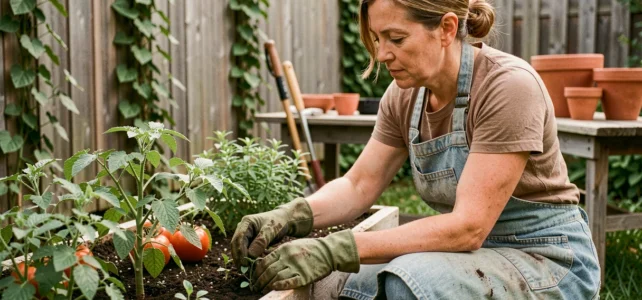
A rosebush that languishes in May, salads going to seed as early as June, soil as hard as concrete in August: these situations rarely indicate a lack of motivation. They rather signal a mismatch between what the garden requires at a specific moment and what is provided. Successfully maintaining a garden year-round relies less on the time spent and more on the right action at the right time.
Living soil: the foundation most gardeners neglect
Have you noticed that some plots produce abundantly without fertilizers, while others stagnate despite regular inputs? The difference often lies in the biological life of the soil.
A healthy soil hosts microorganisms, earthworms, and fungi that decompose organic matter and transform it into assimilable nutrients. When this life disappears (due to bare, compacted, or chemically treated soil), plants become dependent on external inputs.
Permanent mulching protects the soil and nourishes its fauna. Dead leaves in autumn, dried grass clippings in spring, straw or shredded branches in summer: each season offers suitable material. A layer of a few centimeters is enough to limit evaporation, slow down weeds, and maintain a stable temperature at the root level.
Before planting or sowing, take a handful of soil. If it crumbles without forming a ball, it lacks clay and organic matter. If it sticks and remains compact, it needs aeration. In both cases, well-decomposed compost incorporated on the surface improves the structure without disturbing the deeper layers. To delve deeper into the garden with Jardiner Facile, you will find useful guidelines on choosing amendments based on your soil type.
Sowing and planting calendar: anticipate rather than catch up
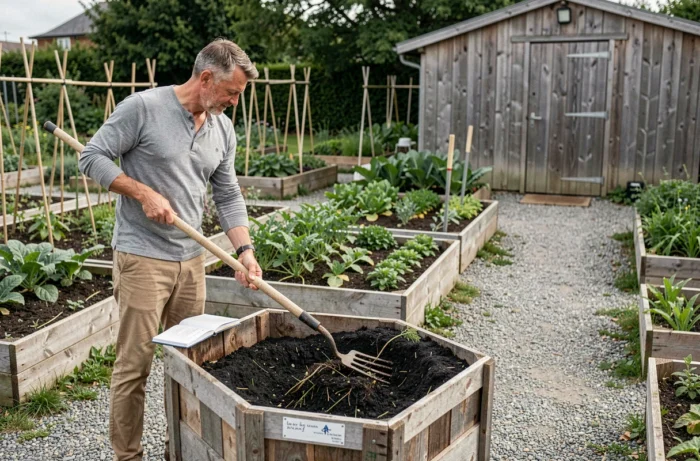
The classic reflex is to buy seedlings in spring and install everything at once. The result: a peak of work in April-May, followed by a garden that empties out by September.
Spreading sowings over several months ensures continuous harvests. A concrete example: radishes sown every three weeks from March to September produce without interruption. Green beans accept staggered sowings from May to July. Winter salads (lamb’s lettuce, chicory) are sown in August for harvest until December.
Combining plants to save space and time
Some combinations work well in the vegetable garden. Carrots and leeks protect each other from their respective pests (the carrot fly and the leek borer). Squashes cover the ground at the base of corn, limiting weeding.
Other combinations should be avoided. Tomatoes and fennels hinder each other. Potatoes and sunflowers compete for the same resources. Observing your plants’ reactions from year to year remains the best guide.
Garden watering and water restrictions: what the law imposes
Watering is the most sensitive aspect of summer gardening, and not just for botanical reasons. Regulations strictly govern water usage, even for private individuals.
Prefectural orders for water restrictions, published every summer in most departments, can completely prohibit watering gardens during a crisis. Failure to comply with these orders can result in a fine of up to 1,500 euros, increased to 3,000 euros in case of repeat offenses. Inspections exist, as regularly reminded by national press articles.
Collecting rainwater: free or regulated?
A simple outdoor rainwater collector not connected to the house’s network is free to install. The situation changes as soon as one wishes to supply indoor equipment (toilets, washing machines) or create a dedicated network: a declaration at the town hall then becomes mandatory, in accordance with articles R.2224-9 and R.2224-19-4 of the General Code of Local Authorities.
Private wells and boreholes: a mandatory declaration
Since January 1, 2009, any well or borehole for domestic use extracting up to 1,000 m³ per year must be declared at the town hall, even for simple garden watering. Failure to declare constitutes a 5th class offense, with a fine of up to 1,500 euros (3,000 euros for repeat offenses). This obligation arises from law n°2006-1772 on water and aquatic environments, supplemented by decree n°2008-652.
Water-saving watering techniques for gardening despite drought
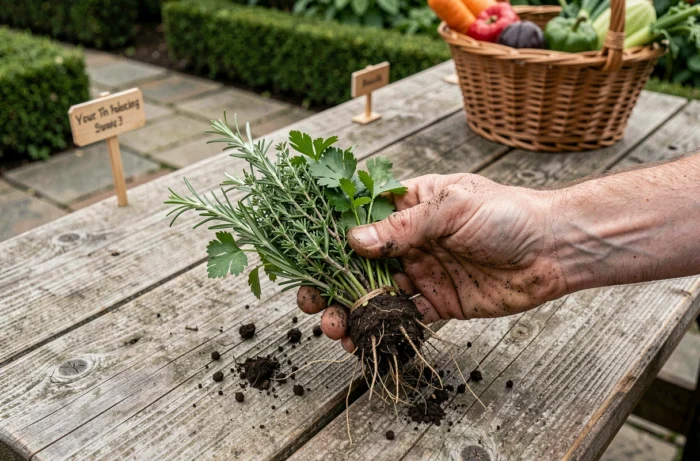
Rather than watering often and lightly, the most effective method is to water infrequently but deeply. A generous watering once or twice a week encourages roots to grow deeper in search of moisture, making plants more resilient to heat stress.
Here are concrete actions that reduce water consumption in the garden:
- Water early in the morning or late in the day to limit evaporation, never in full sun
- Install a thick mulch at the base of vegetables and shrubs to retain soil moisture
- Favor drip irrigation or oyas (buried clay pots) that deliver water directly to the roots
- Choose varieties suited to your climate: heirloom tomatoes in dry areas, squashes instead of zucchinis if water is scarce
A well-mulched garden with targeted watering consumes two to three times less water than a garden watered with a hose on bare soil.
Autumn and winter maintenance: preparing for the next season
A common mistake at the end of the season is to clean everything up, leave the soil bare, and wait for spring. The garden, however, does not stop.
In autumn, dead leaves collected from the lawn find their place on flower beds and in the vegetable garden as natural mulch. Green manures (mustard, phacelia, rye) sown in September occupy the soil, prevent nutrient leaching from rain, and will be mowed in spring before new plantings.
A covered soil in winter restarts faster in spring. Earthworms remain active under the plant cover and continue their aeration work. The prepared growing beds often require just a quick raking before the first sowings in March.
Winter is also the time to observe: note what worked, identify areas of shade that expand with tree growth, plan crop rotations to avoid depleting the soil by replanting the same vegetables in the same spot. This logbook, even if brief, is worth all the gardening tips combined.