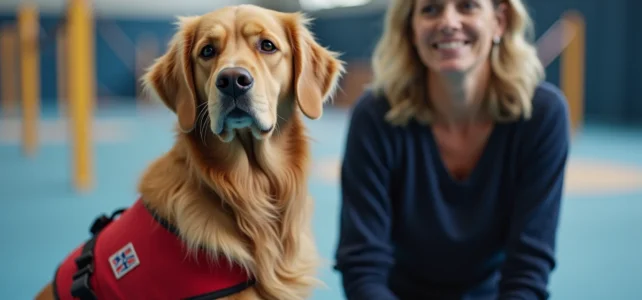
An assistance dog is an animal selected, trained, and certified by a recognized center to compensate for the disability of a person holding a mobility inclusion card (CMI). This definition, as simple as it may seem, immediately sets a limit: the majority of companion dogs will never meet these criteria, regardless of the training received at home.
Selection and abilities of the assistance dog: what temperament determines before training
Before any education, an assistance dog goes through a behavioral selection phase. Certified centers evaluate emotional stability, stress tolerance, prolonged attention capacity, and sociability with various human profiles.
A dog that is reactive to loud noises, anxious in urban environments, or too excitable around peers will be dismissed, even if it knows dozens of commands. Temperament takes precedence over obedience. This distinction explains why certain breeds often appear in programs (Labradors, Golden Retrievers, Standard Poodles), not out of tradition, but because their genetic profile favors the desired traits.
An individual wishing to explore this path with their own dog will find detailed resources on service dog training on Animaleo, but it is important to keep in mind that the initial evaluation remains the first and most stringent filter.
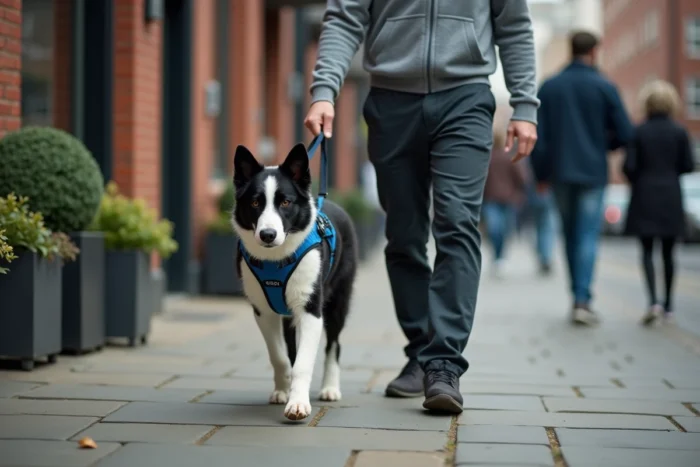
Training pathway in a certified center: duration, methods, and certification
The education of an assistance dog at HANDI’CHIENS lasts about 22 months. This period covers socialization in a volunteer foster home, learning commands specific to the targeted disability, and then real-life situations in public places, transportation, and work environments.
The training relies exclusively on benevolent methods, without physical constraints. The dog learns through positive reinforcement to open doors, pick up objects, alert to a sound signal, or stabilize a person in a wheelchair.
Key steps in the center’s pathway
- Placement in a volunteer foster home from a young age for daily socialization (varied environments, multiple human contacts, habituation to transportation).
- Specialized education phase with a canine educator trained in disabilities, where the dog learns technical tasks suited to a specific mission (motor assistance, hearing aid, educational support).
- Certification by the center after a final evaluation, followed by assignment to a compatible beneficiary, and then an intensive matching class period to create the duo.
The dog remains the property of the certified center and is provided free of charge to the beneficiary. This model ensures follow-up throughout the active life of the animal.
Can you train your own companion dog as a recognized assistance dog?
The short answer: within the French legal framework, a recognized assistance dog must come from a certified center or one in the process of certification. This certification is issued by the prefecture of the department. Without it, the dog does not benefit from the access rights to public places provided by law.
Some programs, such as those from Canischola in Belgium, support individuals who wish to develop their dog’s skills for emotional support or animal mediation. This type of training produces dogs that are useful in daily life, but that do not carry the legal status or the identifiable vest of an official assistance dog.
Concrete reasons for the exclusion of most companion dogs
A dog adopted as an adult, for example, often misses the early socialization window. A breed-appropriate dog but from a working lineage (hunting, sport) may exhibit a level of excitement incompatible with the calm required in hospital or school environments.
The standardized behavioral evaluation eliminates the majority of candidates, including among breeds known for their docility. The percentage of dogs that actually complete the full pathway remains limited compared to the number of dogs engaged in the initial phase.
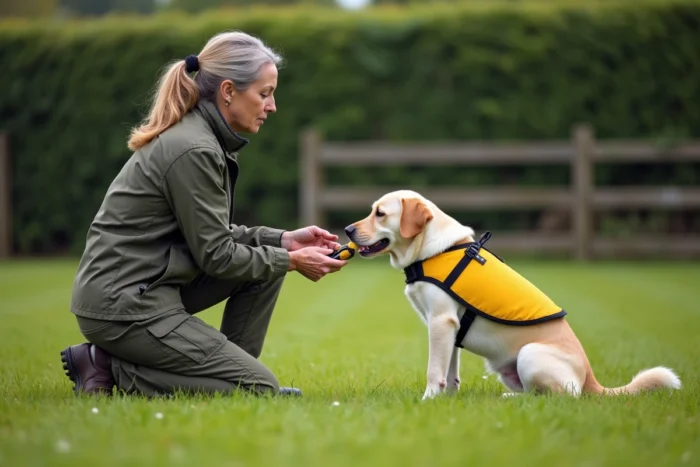
Post-assignment follow-up and beneficiary eligibility conditions
The education of the dog represents only half of the work. The other half concerns the beneficiary. The most structured programs, such as that of the Mira Foundation, impose weeks of matching classes followed by annual follow-up of the duo.
The beneficiary must demonstrate their ability to manage the dog on a daily basis: feeding it, walking it, maintaining learned commands, and communicating clearly with it. Success depends as much on the duo’s support as on the initial education.
Common eligibility conditions
- Holding a valid CMI corresponding to the type of disability covered by the program.
- Having a compatible living environment (suitable housing, absence of other problematic animals, presence of an informed support network).
- Actively participating in the matching class phase, which can last several weeks in immersion with the animal.
- Accepting regular post-delivery follow-up, with evaluation visits by the center’s educator.
HANDI’CHIENS also develops support dogs whose role relies more on presence and relationship than on technical tasks. This newer category addresses emotional or psychological needs without requiring the same level of physical ability from the beneficiary.
AMA, another specialized actor, emphasizes a tailored approach where each dog is adapted to the needs, age, and specific disability of the person, rather than a standardized model. The current trend is towards personalized duos, not towards generic training.
The vocabulary “transforming your dog into an assistance dog” remains misleading. The actual process resembles a rigorous selection process, conducted by professionals trained in disabilities, where both the animal and the beneficiary are evaluated with the same level of demand. The waiting times, sometimes long, reflect this rigor, not a lack of resources.