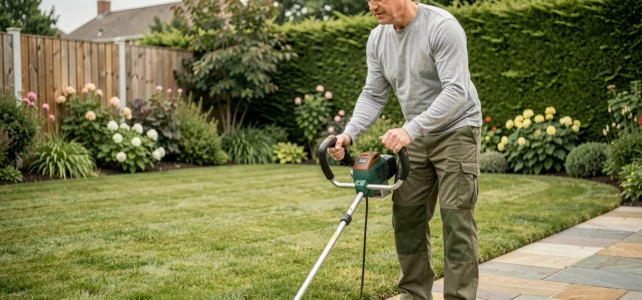
A string trimmer and a brush cutter share a similar silhouette: a tube, a motor, and a rotating cutting system. The resemblance ends there. The former is designed for finishing touches on soft grass, while the latter is meant to tackle woody vegetation and thick underbrush. Confusing the two leads to an unsuitable purchase, either too fragile or oversized.
Cutting System: Nylon Line vs. Steel Blade
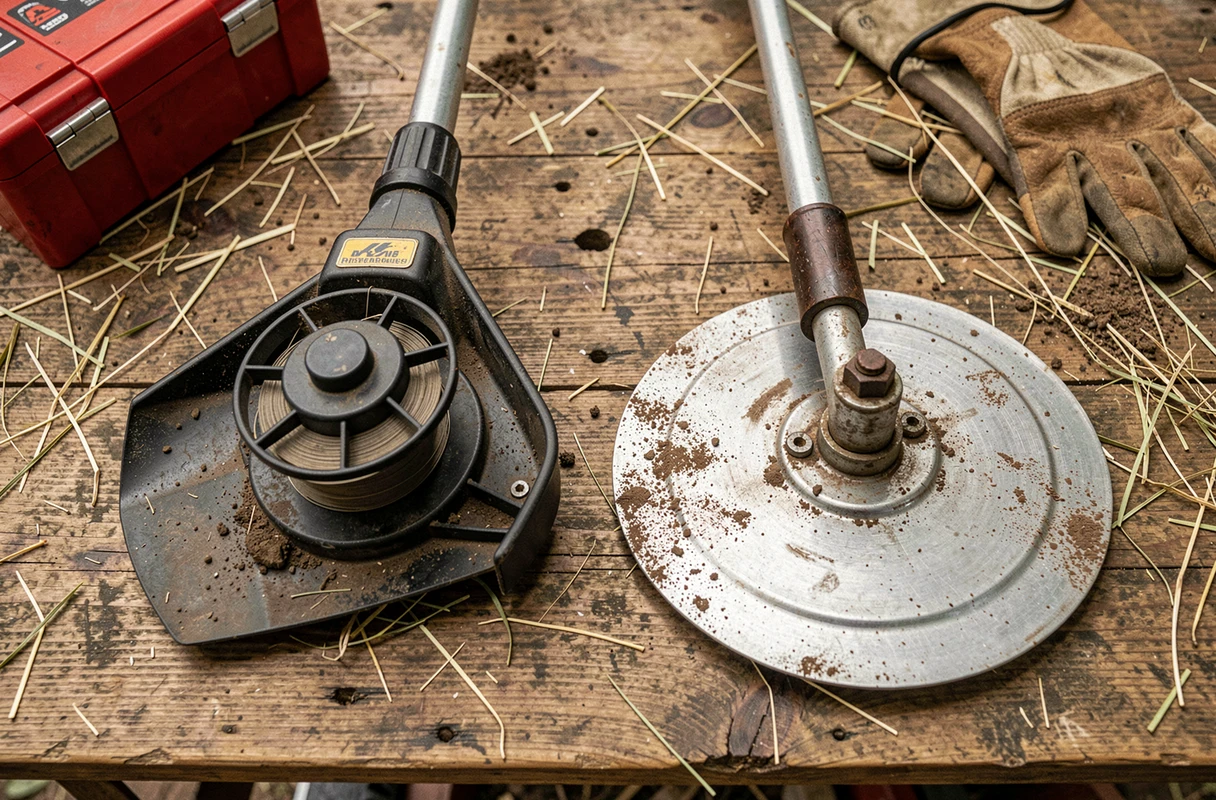
This is the fundamental technical divergence. The string trimmer operates with a nylon line that spins at high speed to cut through soft grass blades. This line breaks or wears out when it comes into contact with hard obstacles (stones, roots), which intentionally limits the cutting force and protects the user.
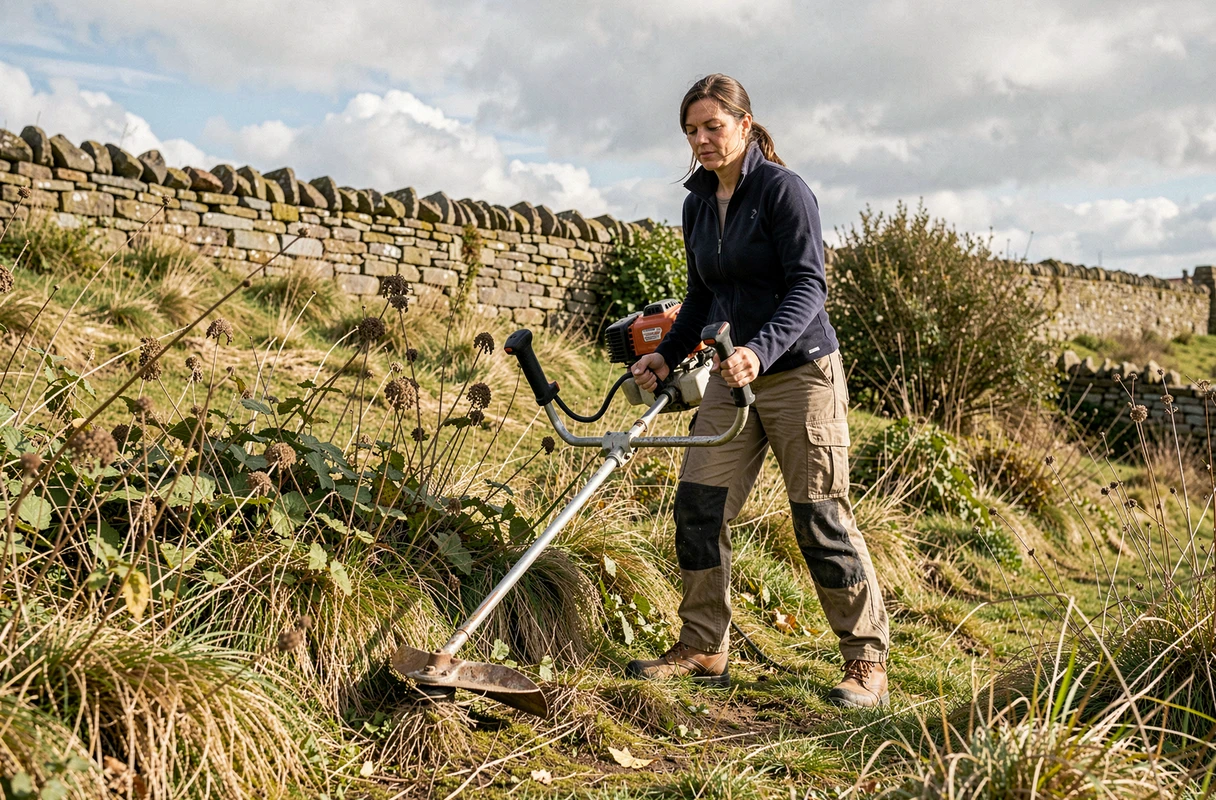
The brush cutter, on the other hand, accepts steel blades or knives capable of slicing through semi-woody stems, brambles, and even young shrubs. Some models also use reinforced nylon line, but it is the ability to mount a metal blade that truly defines a brush cutter.
The practical rule can be summed up in one sentence: if the vegetation resists the nylon line, a brush cutter is needed. If the line cuts through effortlessly, the string trimmer is sufficient. Understanding the difference between string trimmers and brush cutters thus begins with identifying the type of vegetation to be dealt with.
Battery, Corded, or Gas-Powered: Impact on Choice
The type of power source affects both the user experience and the cutting system. Three categories coexist, each with distinct trade-offs.
- Lithium-ion battery: total freedom of movement, reduced noise level, limited autonomy to a few dozen minutes depending on capacity. Suitable for medium-sized residential gardens, both as a string trimmer and a lightweight brush cutter.
- Corded (electric plug-in): constant power, manageable weight, but limited range due to the cord. Reserved for string trimmers used close to the house.
- Gas-powered: the most powerful motorization, essential for brush cutters intended for intensive clearing. The weight, noise, and mechanical maintenance (spark plug, filter, mix) are significantly higher.
The current trend pushes battery-powered options to the forefront for domestic use. Gas-powered remains relevant when the area to be cleared is vast or when the vegetation requires sustained power over long sessions.
Pivoting Head and Edger: The Boundary Blurs
Several recent string trimmers incorporate a pivoting head at 90° or 180° that allows for vertical work along paths, walls, and flower beds. This function, called an edger, transforms the finishing tool into a sculptor of clean edges.
This technical detail does not always appear in general comparisons, even though it changes the cost/utilization ratio. A string trimmer equipped with an adjustable head covers two uses (horizontal finishing and vertical cutting of edges) without the need for additional accessories.
The brush cutter generally does not offer this pivoting feature. Its design prioritizes power and tube rigidity to withstand cutting efforts on dense vegetation. The ergonomics are designed for sweeping large areas in lateral motion, not for centimeter-precise work.
Multifunction Brush Cutter: One Tool for Multiple Tasks
An increasingly common purchasing angle is to choose a brush cutter as the base of a combined tool system. The motor block remains the same, and interchangeable accessories allow switching from brush cutting to string trimming, hedge trimming, or pole sawing.
This format appeals to owners of large properties who want to limit the number of machines stored. The space-saving is real, but the quality of each accessory must be checked individually. A “combined” hedge trimmer does not always compete with a dedicated model in terms of cutting precision and comfort.
For a residential garden already maintained by a lawn mower, the multifunction logic is rarely cost-effective. A lightweight string trimmer fulfills the finishing task at a lower cost and with less fatigue.
String Trimmer or Brush Cutter: Decision Criteria Based on Terrain
The choice boils down to three concrete variables: the type of vegetation, the area, and the frequency of use.
- Regularly mowed garden with edges along paths, walls, or flower beds: the string trimmer (battery or corded) is sufficient. Prefer a model with an edger function for more versatility.
- Partially overgrown land with tall grasses, brambles, or shrub regrowth: the brush cutter is necessary, preferably with the option to mount a steel blade.
- Large property with maintained areas and wild zones: both tools are complementary, the string trimmer for finishing near the house, the brush cutter for remote areas.
Weight also plays a role. A battery-powered string trimmer can be operated one-handed for short sessions. A gas-powered brush cutter requires a harness and puts strain on the back and arms over time. Underestimating this factor often leads to a tool that stays in the garage.
The purchase budget is only part of the equation. The maintenance of a gas engine (oil change, spark plug, air filter, oil-gas mix) represents recurring costs and time that the battery almost entirely eliminates. A well-sized battery-powered string trimmer for a modest-sized garden remains the simplest option for daily use, while a gas-powered brush cutter retains its place whenever the terrain truly demands it.