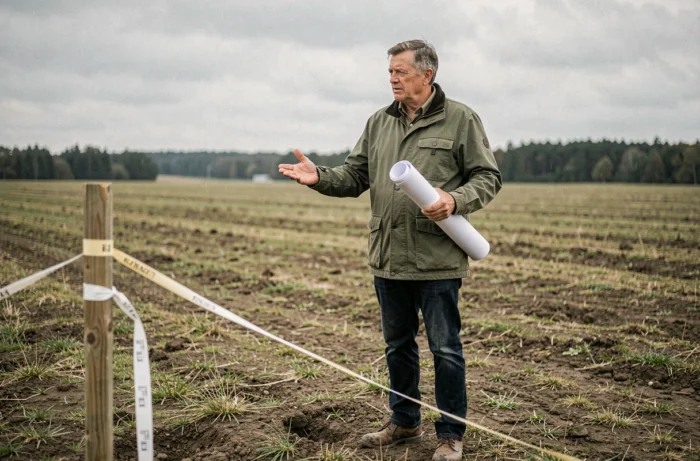
A plot of land given away for free does exist, but the legal and financial reality behind this arrangement deserves careful examination. Between the unavoidable notary fees, the urban planning conditions to check, and the preferred search channels, the free land does not mean the absence of costs. This article compares the different ways to access these plots and details what each option concretely implies for building your project.
Actual costs of a free land donation: notary fees and taxation
The word “for free” often creates confusion. A plot transferred without a sale price is still subject to a real estate transfer, which requires going through a notary and publishing the deed with the land publicity service. These formalities generate unavoidable costs.
| Expense Item | Donated Land (0 euros) | Low-Priced Land Purchase |
|---|---|---|
| Acquisition Price | None | Variable depending on the local market |
| Notary Fees | Mandatory (fees, land publicity taxes) | Mandatory, proportional to the price |
| Donation Rights | Applicable depending on the relationship with the donor | Not applicable |
| Development Tax | Due if construction | Due if construction |
| Soil Study | Charged to the beneficiary | Sometimes included in the lot |
Even without financial compensation, the notarial transfer remains mandatory to be enforceable against third parties. In the absence of this publication, the land does not legally belong to you, which blocks any building permit.
Donation rights vary significantly depending on the relationship between the donor and the beneficiary. A donation between parents and children benefits from significant reductions, while a gift between unrelated individuals may lead to taxation close to the estimated value of the property.

Search channels for a plot of land to give away: platforms, town halls, and networks
Advertisements for free plots circulate through very different channels, and their effectiveness depends on the type of project. Consulting the listings of land to give away for free on Recherchimmo allows for centralizing a watch on offers from individuals, but this is just a starting point.
Town halls represent an underutilized channel. Some rural municipalities, facing demographic decline, offer buildable lots for free or for a symbolic amount to attract new residents. These schemes are rarely disseminated on large real estate platforms.
- Specialized real estate listing platforms gather offers from individuals wishing to transfer land, often to relieve themselves of maintenance and property tax burdens
- The urban planning services of rural town halls sometimes publish calls for projects or transfers of municipal parcels, which can be consulted at the town hall or on the community’s website
- Associative and cooperative networks (like Terre de Liens for agricultural projects) connect project holders and landowners willing to transfer
- Local word-of-mouth and local notaries remain the channels through which many opportunities never published online pass
Land given by municipalities often comes with conditions: obligation to build within a defined timeframe, prohibition of resale for several years, or adherence to an architectural specifications document. Check these conditions before committing.
Checking the buildability of a donated plot: urban planning and soil study
Receiving land for free does not guarantee the right to build on it. Buildability depends on the local urban planning plan (PLU) of the municipality, which classifies each parcel as urban, to be developed, agricultural, or natural. Only the first two categories allow for the construction of residential buildings.
The urban planning certificate remains the reference document for knowing the rights attached to a parcel. It exists in two versions: the information certificate (applicable rules) and the operational certificate (feasibility of a specific project). The town hall issues it within one to two months.
The soil study, made mandatory in certain areas by the Élan law, represents an expense to anticipate. A clayey, flood-prone plot, or one located in a shrink-swell zone requires adapted foundations, the additional cost of which may call into question the economic interest of free land.
- Request the operational urban planning certificate specifying the nature of the proposed project
- Consult the zoning of the PLU on the urban planning geoportal to identify constraints (flood zone, historical monument perimeter, classified wooded area)
- Have a minimum G1 geotechnical study conducted if the land is located in an identified clay sector
A plot classified as agricultural (A) or natural (N) cannot accommodate a residential house, except for very strictly regulated exceptions. A non-buildable free plot has no utility for a construction project.
Land holding and alternatives to pure donation for building a project
Pure donation is not the only way to access land without heavy initial investment. In recent years, land holding schemes have been developing, particularly for agricultural projects. A fund supported by FNSafer and Citizen Capital offers long-term land holding, aimed at installations outside the family framework. The land remains owned by the fund while the operator pays a moderate rent, with an option for deferred purchase.
Land holding is gradually replacing pure donation in the agricultural sector. This arrangement provides legal security for both parties and avoids the tax complications associated with donations between unrelated parties.
For residential construction projects, some municipalities practice emphyteutic leases or construction leases. The land remains municipal property, but the beneficiary obtains a long-term real right (often several decades) allowing them to build and occupy the premises.
The free nature of a plot does not eliminate transfer fees, urban planning constraints, or the need for a soil study. The best opportunities are often found outside traditional platforms, in rural town halls or through local notaries. Checking buildability before any steps avoids months of unnecessary procedures.