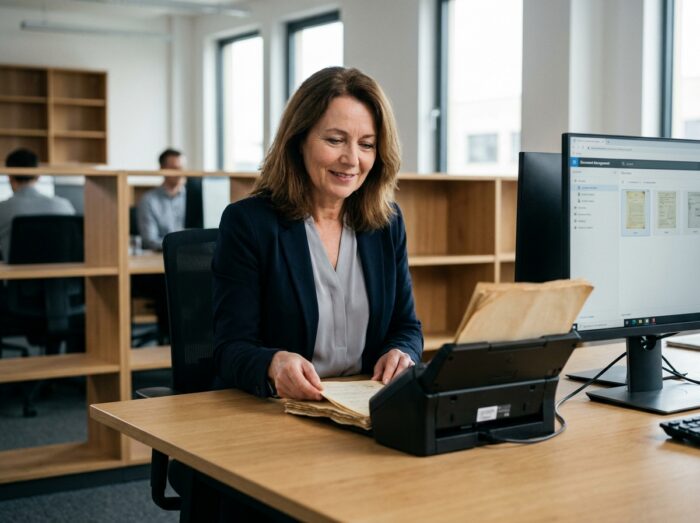
Every year, thousands of payslips, certificates, and career statements pile up in binders. On retirement day, these documents must be found to assert pension rights. The problem is that some documents date back several decades, are yellowed, illegible, or even lost. The digitization of paper files is no longer a distant option; it is a movement already underway in French administrations.
Hybrid retirement file: when digital only covers part of the career
You may have already accessed your payslips online through ENSAP (Secure Digital Space for Public Agents) if you are a state employee. This portal centralizes digitized payslips and information related to retirement rights. In theory, it is a considerable advancement.
In practice, payslips prior to digitization are still absent from the portal. According to the ministries, the digital history generally dates back to the years 2016-2018. Everything before that, which often constitutes the majority of a career for employees nearing retirement, must be requested from former HR services in paper format.
A civil servant’s retirement file is therefore often hybrid: a solid digital base for the last years, and total reliance on paper for older periods. This gap creates a real risk of gaps in the career statement, with direct consequences on the pension calculation.
For private sector employees, the situation is similar. Complementary schemes offer online spaces, but proof of periods of unemployment, illness, or partial activity prior to digitization still requires physical documents. Choosing a GED software that fits allows for the digitization and organization of these archives before they become untraceable.
The “tell us once” principle: what administrations are really changing
French administrations are working on a simple principle: no longer requesting a document they already possess. This logic, sometimes referred to as “tell us once,” aims to reduce the back-and-forth of supporting documents between users and various organizations.
In concrete terms, this means that pension funds, tax services, and social organizations are gradually sharing data among themselves. A civil status act or a rights certificate would no longer need to be provided multiple times by the same insured individual.
What is the status of this interconnection for retirement files?
The deployment remains uneven. Online retirement applications are progressing, with pre-filled forms based on data already known to the schemes. Some funds now accept the submission of digitized documents directly on their portals.
Reversion procedures often remain more complex, as they involve family documents (family record book, death certificate) that do not yet circulate automatically between administrations. The surviving spouse must then provide originals or certified copies, sometimes to several distinct organizations.
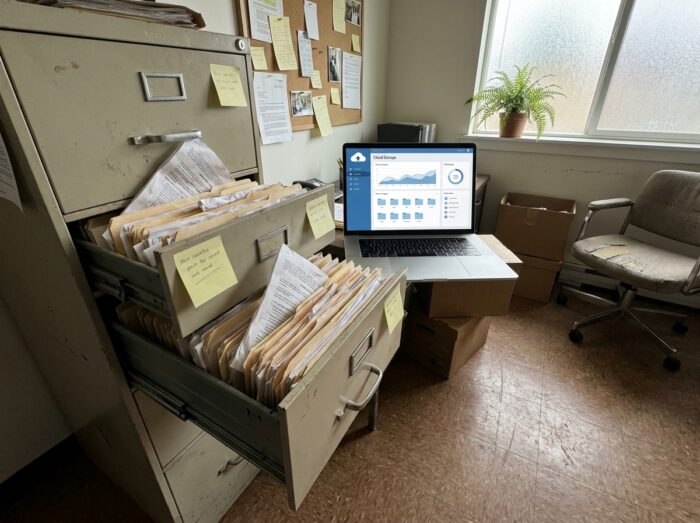
This gap between the ambition of “tell us once” and the reality on the ground explains why paper files do not disappear overnight, even when digital tools exist.
Digitizing personal archives: a concrete method before retirement
Waiting until pension liquidation to search for documents is the classic trap. Sorting and digitizing should be done several years before retirement. Here are the categories to prioritize:
- Payslips from the entire career: they serve to prove periods of activity in case of disagreement with the career statement. Digitizing them in PDF with naming by year facilitates searching.
- Employment contracts and certificates: they document changes of employer, part-time work, or unvalidated trial periods. A double-sided scan is sufficient.
- Pôle emploi (France Travail) certificates and daily allowance statements: these documents cover periods of unemployment or illness that count for quarters. They are often lost first.
- Pension certificate and notifications from the pension fund: to be kept indefinitely, including after retirement. These are the proofs of your acquired rights.
A flatbed scanner or a mobile scanning app provides sufficient results for most administrative uses. The issue is not photographic quality but the readability of the text and preservation on a reliable medium (external hard drive, secure online storage service, or both).

Should originals be kept after digitization?
The answer depends on the type of document. Civil status acts, property titles, and the pension certificate should be kept in original form. For payslips, a well-archived digital copy replaces the original in most procedures, but some funds may still require the paper version in case of appeal or dispute.
It is prudent to keep the originals of documents with unlimited retention periods and to digitize everything else before disposing of them.
Appeals and pension disputes: paper remains a difficult proof to replace
In case of disagreement over the amount of the pension or the number of validated quarters, the burden of proof rests on the insured individual. The career statements provided by the schemes sometimes contain errors, missing periods, or incorrect amounts.
In this context, a paper payslip or an employer’s certificate constitutes the most direct proof. Courts and appeals commissions accept digitized copies, but an original retains superior evidentiary value when there is doubt about authenticity.
Checking your career statement several years before retirement allows you to spot anomalies and gather the necessary supporting documents while former employers or departmental archives are still accessible. Once the company is dissolved or the archives are destroyed, reconstruction becomes very difficult.
The transition to all-digital does not eliminate this need for vigilance. It shifts it: instead of filing cardboard folders, one must organize digital files with the same rigor. The format changes, but the requirement for proof remains the same.