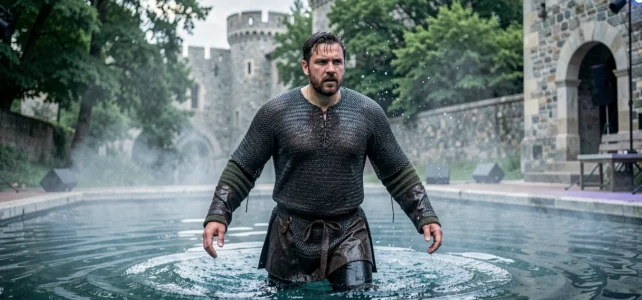
During the show Les Vikings at Puy du Fou, Nordic warriors magically emerge from the lake, to the astonishment of the audience. The effect is striking: the actors seem to rise from nowhere after spending long seconds submerged. This feat relies on a set of very real techniques, blending stage engineering, physical training, and rigorous safety protocols.
Apnea and Hidden Breathing: What the Actors Really Do Underwater
Have you ever noticed that the Vikings stay submerged much longer than a simple dive would allow? The key lies in two words: controlled apnea and concealed air supply.
The stunt performers at Puy du Fou undergo specific training to control their breath underwater. They work on their static apnea capacity, as well as their stress management while submerged. The goal is not to break records, but to hold their breath long enough for the staging to work.
For the longest sequences, discreet air supply devices are installed beneath the surface. These systems, invisible from the stands, allow the actors to take a quick breath before surfacing. The audience sees only one thing: a warrior bursting from the lake, weapon in hand, as if he had always been there.
For a more detailed explanation of the actors’ emergence from the water at Puy du Fou, the mechanism thus combines physical preparation and technical ingenuity.
Submerged Platforms and Machinery Under the Lake at Puy du Fou
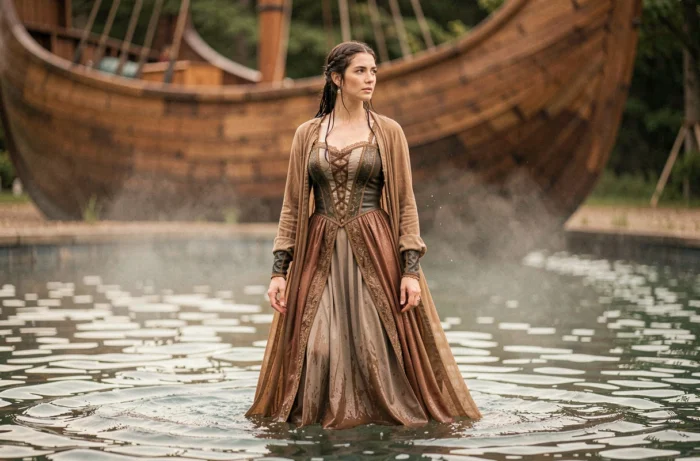
The illusion does not rely solely on the actors’ lungs. The lake of the show is an entirely scenographed set, with a bottom equipped with fixed and movable structures.
Submerged platforms, positioned at precise depths, serve as support points for the stunt performers. Some are fixed and mark the exact spots where the actors must stand before bursting forth. Others are height-adjustable thanks to hydraulic jacks, allowing the staging to be adapted according to the needs of the show.
Why the Audience Sees Nothing
The water in the lake is intentionally opaque. Its dark hue prevents spectators from distinguishing anything beneath the surface. This opacity is not by chance: it is an integral part of the scenic design.
The actors take their positions underwater a few seconds before their appearance, guided by tactile markers at the bottom of the pool. The timing is precise. An audible and invisible sound or light signal from the stands triggers the simultaneous rise of several Vikings.
- Ground markers allow the actors to position themselves exactly in the right spot, even with zero visibility
- The hydraulic jacks lift certain platforms to accelerate the emergence and amplify the element of surprise
- The low lighting on the lake is synchronized with the actors’ emergence, creating a visual contrast that enhances the illusion
Water Safety: The Invisible Protocols of the Show
Making actors emerge from a body of water multiple times a day, in front of thousands of spectators, imposes strict safety standards. Puy du Fou leaves nothing to chance on this point.
Rescue swimmers are permanently assigned to the water during each performance. These lifeguards, positioned out of the audience’s line of sight, are ready to intervene in case of an unexpected fall or problem beneath the surface. Their presence is systematic, not optional.
The recruitment of artists reflects this requirement. The park’s job descriptions explicitly mention profiles of “fighter/stunt performer” capable of performing stunts related to water and fire, with formalized technical and safety protocols for these mixed environments. This professionalization of artists required to work in water has strengthened in recent years.
Training and Rehearsals in Real Conditions
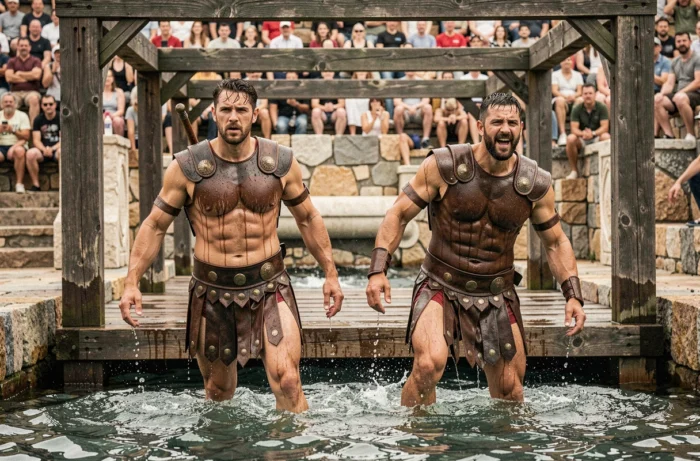
Before the season, the stunt performers rehearse each aquatic sequence dozens of times. They train to enter the water without visible splashes, to maintain their submerged position, and then to emerge with the energy of a Viking assailant.
Rehearsals take place in the show pool, under conditions identical to the performance. The water temperature, the weight of wet costumes, and the resistance of props are integrated into each session. A Viking helmet soaked in water does not wear like a dry helmet: the artists learn to compensate for this extra weight to maintain fluid and credible movement.
Aquatic Show and the Water Effects that Complete the Illusion
The actors are not the only elements to emerge from the lake. Puy du Fou uses custom-designed water effect technologies, particularly for the Cinéscénie and the show Les Orgues de Feu.
The company Aquatique Show has created a large-scale aquatic show to accompany the Cinéscénie. Programmable water jets, water curtains (like the Aqua Graphic curtain used in “Le Premier Royaume” to illustrate the baptism of Clovis), and synchronized fountains create a visual environment that diverts attention at the precise moment when the actors position themselves beneath the surface.
- The water jets mask the surface movements caused by the stunt performers submerging
- The water curtains serve as projection screens, adding a narrative layer while concealing the preparations
- The synchronization between water effects, pyrotechnics, and the emergence of the actors is managed by a centralized control
Each aquatic show at Puy du Fou thus combines human performance and invisible machinery. The water effects are not merely decorative: they actively participate in the illusion by covering the actors’ preparation phases.
Ultimately, the secret of Puy du Fou lies in this combination: artists trained in apnea and aquatic combat, a meticulously planned underwater scenography, strict safety protocols with dedicated lifeguards, and a layer of aquatic special effects that makes everything perfectly invisible from the stands. What appears to be magic is based on months of preparation and engineering that the audience is not meant to suspect.