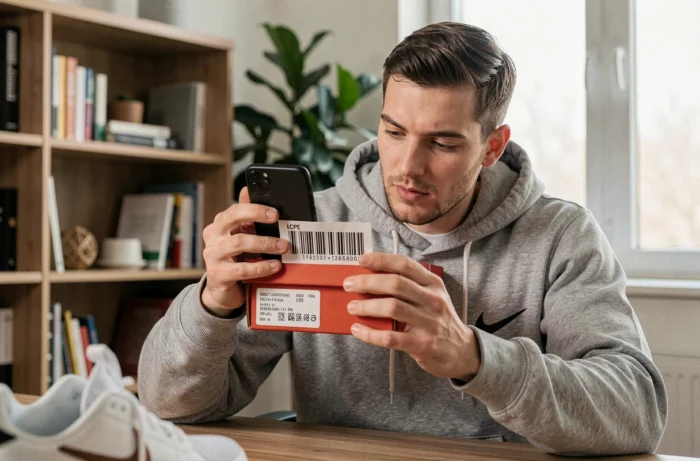
A twelve-digit UPC code on a Nike box does not guarantee that the pair is authentic by itself. Counterfeiters now reproduce valid barcodes copied from real products. The question is not whether the UPC code is readable, but understanding what it encodes, what it does not cover, and how to cross-reference it with other identifiers to ensure a reliable online purchase.
Limitations of the Nike UPC Code Against Current Counterfeiting Methods
The UPC (Universal Product Code) identifies a product in commercial databases. It encodes the brand, product reference, and a check digit. However, the UPC code does not encode the size or colorway of a pair of Nike shoes.
This technical limitation has a direct consequence: a counterfeiter can affix an authentic UPC code, copied from an original box, onto packaging containing a counterfeit pair. Scanning the barcode will then return a positive result on databases like Barcode Lookup or Barcode Spider, without proving anything about the actual contents of the box.
Anti-counterfeiting control is gradually shifting from the product to the sales platform. Under the Digital Services Act (DSA), European marketplaces must now collect and display verification information about professional sellers and report offers identified as illegal. The reliability of the platform thus becomes a criterion in its own right, beyond simply reading a barcode.
The procedure for verifying the Nike UPC code only gains its full value when combined with other checks, detailed in the following sections.
UPC Code, Model Number, and Nike QR Code: Comparison Table
Each pair of Nike shoes carries several identifiers. They do not protect against counterfeits in the same way. The table below summarizes what each marking encodes and its concrete limitations for an online buyer.
| Identifier | Location | Encoded Content | Main Limitation |
|---|---|---|---|
| UPC Code (12 digits) | Box / outer label | Brand, product reference, check digit | No size or colorway, easily copied |
| Model Number (style code) | Sewn inner label | Exact model, colorway, version | Requires physical access to the shoe |
| QR Code / NFC Chip | Inner label (recent models) | Link to Nike database, product data | Absent on older models |
The model number is more discriminating than the UPC code for verifying authenticity. It identifies a specific colorway and can be verified on the Nike website by entering the style code in the search bar. If the product page returned does not match the model claimed by the seller, the alert is immediate.
The internal QR code, present on recent pairs, adds an additional level of control. Scanned via the Nike app, it allows direct access to the product data in the brand’s database. Counterfeiters find it more difficult to reproduce this dynamic link than a simple static barcode.
Cross-Referencing Nike Codes: The Method That Reduces Risks
Checking a single identifier is not enough. The reliability of the check relies on cross-referencing multiple elements, done before validating an online purchase.
Step by Step: Cross-Referencing UPC, Style Code, and Visual Data
- Scan or enter the UPC code on Barcode Lookup or Barcode Spider, then note the model and brand returned by the database. If no result appears, that’s a strong alert signal.
- Compare the model number (style code) visible on the inner label of the shoe with the product page on nike.com. The style code must exactly match the colorway and model claimed.
- For recent pairs, scan the internal QR code via the Nike app to verify the consistency between the digital data and the physical product.
- Check that the size indicated on the inner label matches the one printed on the box. A discrepancy between these two mentions is a frequent marker of counterfeiting.
This cross-referencing approach makes counterfeiting significantly more difficult to maintain. Simultaneously reproducing a valid UPC code, a consistent style code, a functional QR code, and a correct inner label requires a level of sophistication that most fakes do not achieve.
Platform Reliability: An Often Overlooked Criterion
The DSA imposes stricter reporting and removal mechanisms on European marketplaces. For a buyer, this means that the choice of platform weighs as much as product control.
eBay has strengthened its authentication service for sneakers in the UK: eligible shoes now undergo a physical inspection before delivery. This type of service, where a third party verifies the product before it arrives at the buyer, complements the manual verification of codes effectively.
Conversely, a seller on a platform without traceability obligations or authentication service presents a higher risk, even if the codes displayed in the photos seem valid.
Red Flags on Online Nike Listings: What Codes Do Not Show
Some visual and commercial clues complement the verification of codes. A price significantly lower than the usual resale price for a given model remains the most reliable signal even before looking at a barcode.
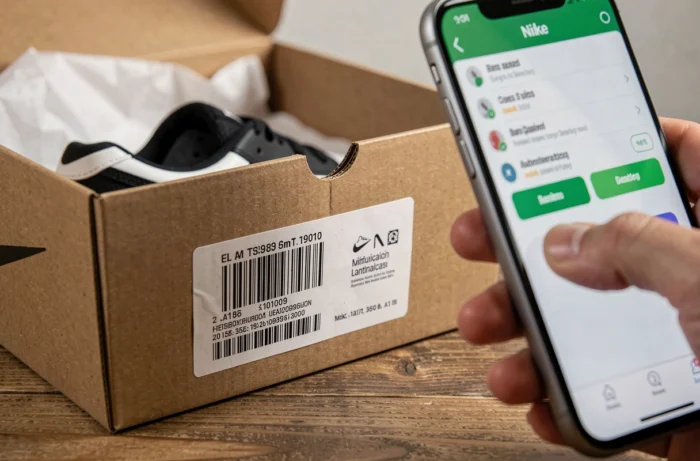
In the listing photos, the typography of the inner label deserves particular attention. Nike uses a specific font with regular spacing between characters. Irregularities in alignment, letter thickness, or print quality of the label often betray a counterfeit.
The absence of photos showing the inner label or the bottom of the box (where the UPC code is located) is another signal. A legitimate seller has no reason to hide these elements. Requesting these images before purchasing is a simple reflex that filters out a significant portion of fraudulent listings.
The combination of checking identifiers (UPC, style code, QR code) with an analysis of the platform and visual clues forms the foundation of solid verification. None of these elements taken in isolation is sufficient, but their convergence reduces the risk of purchasing a counterfeit to a marginal level.