
When you approach the aquarium and the goldfish rushes towards the glass, you always ask the same question: does it recognize us or is it just waiting for its food? The distinction may seem slight, but it is based on well-documented biological mechanisms. The goldfish has a long memory, functional vision, and a capacity for learning through conditioning that allows it to discriminate between human individuals.
Operant conditioning of the goldfish: the mechanism behind “recognition”
Affection and association are often confused. What happens in the aquarium is a matter of operant conditioning: the goldfish learns to link a stimulus (your silhouette, your footsteps, mealtime) to a consequence (the distribution of food). Over the days, it adjusts its behavior to maximize the reward.
Specifically, if you are the person who feeds the fish every morning, it will associate your presence with the arrival of food. It will react differently when another person approaches the glass because the silhouette, gait, and habits differ. This is not emotional attachment in the mammalian sense, but it is a measurable form of individual discrimination.
You can check if my goldfish recognizes me by asking someone else to approach the aquarium without food: if the fish does not come to the surface or stays back, it clearly distinguishes between people.
Goldfish memory: far beyond the three-second myth
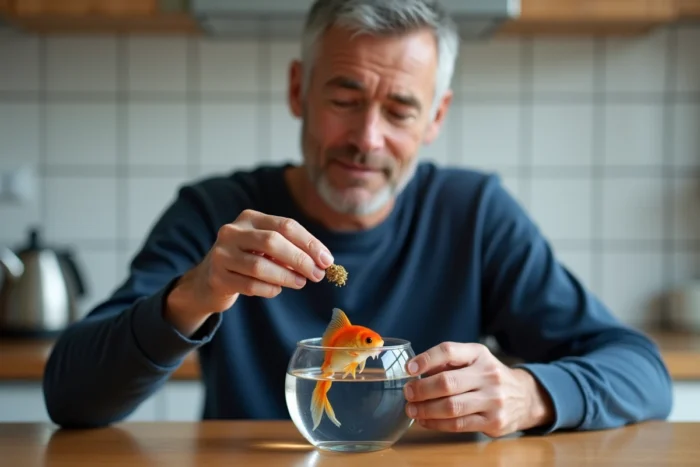
The myth of three seconds of memory has been debunked many times. Goldfish retain learned tasks for more than a year, including spatial routes and feeding routines. This long-term memory makes individual recognition that lasts over time quite credible.
In practice, this means that a goldfish fed by the same person for several months has accumulated enough associations to respond differently to that person. If you go on vacation for two weeks and someone else takes over, the fish will probably react less vigorously to your return, then regain its habits in a few days.
What cues the goldfish uses to identify you
The goldfish does not see the world as we do. Its vision is adapted to the aquatic environment, with sensitivity to contrasts, movements, and certain wavelengths. Through the aquarium glass, it perceives:
- The overall silhouette and relative size of the person approaching, allowing it to distinguish an adult from a child, for example
- Recurring movements associated with feeding (opening the lid, tapping the glass, leaning over the tank)
- The vibrations transmitted through the ground and the structure of the aquarium, particularly your footsteps, which the fish detects via its lateral line
The combination of these visual and vibrational signals forms a “profile” that the goldfish associates with a positive or neutral outcome. Responses vary on this point, but some aquarists report that their fish react differently to family members, even when no one is holding food.
Practical recognition test: how to observe behavior daily
Rather than relying on a vague impression, you can set up a simple protocol to assess whether the fish truly distinguishes its caretaker from a stranger.
Three-step observation protocol
First step: for a week, note the fish’s reaction when you approach the aquarium without food. Does it come to the surface? Does it get agitated? Does it stay still? Always do this at the same time to limit variables.
Second step: ask someone the fish has never seen to approach under the same conditions (same time, same side of the aquarium, no food). Compare the reaction. A fish that stays at the bottom or hides from the stranger but comes up for you marks a significant difference in behavior.
Third step: switch roles for a few days. If the other person starts feeding the fish in your place, observe how long it takes for the fish to transfer its positive reaction to the new caretaker. Generally, a few days are enough, confirming the conditioning mechanism.
Aquarium enrichment and the social behavior of the goldfish
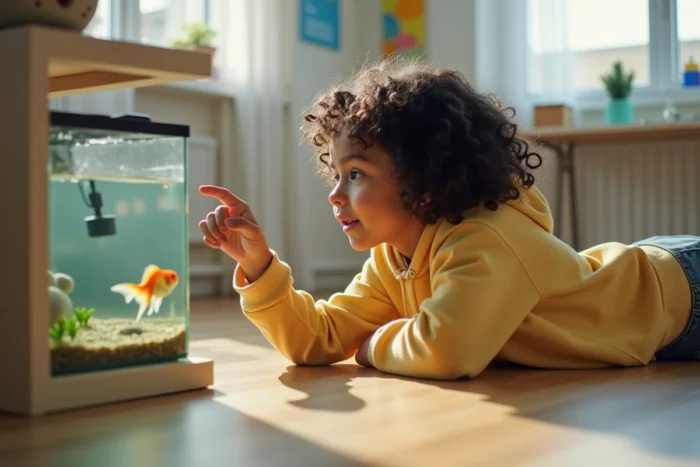
A goldfish kept in an empty aquarium with a filter and nothing else will not show the same level of interaction as an animal raised in a stimulating environment. Environmental enrichment directly influences the fish’s learning ability.
A tank with plants, hiding spots, and enough swimming space encourages the goldfish to explore, memorize its environment, and develop more complex behaviors. In a bare aquarium, the fish has fewer opportunities to engage its cognitive abilities, and its reactions seem more monotonous.
- Add varied decorative elements that you can move from time to time to stimulate exploration
- Maintain clean water with stable parameters, as stress from poor water quality reduces interaction behaviors
- If you keep multiple goldfish, social behavior among individuals also enhances their overall cognitive activity
An active, curious goldfish that spontaneously comes to the glass when its caretaker approaches is not an animal that “loves” in the human sense. It is an animal whose brain functions well, in an appropriate environment, and that has learned that this specific person represents something positive. Recognition exists, but it is based on association, not emotion.
This distinction does not diminish the pleasure of interaction. A well-maintained goldfish in a suitable aquarium develops individualized behaviors that are not found in a stressed or neglected animal. The quality of the breeding environment remains the primary factor determining whether your goldfish will be able to identify you on a daily basis.