
The hedge trimmer market today covers three power families (corded, battery, gas), hundreds of references, and a price range from a few dozen euros to more than twenty times that amount. Choosing the right hedge trimmer involves considering the nature of the hedge, the user’s morphology, and regulatory constraints that many gardeners discover after purchase. Here are the parameters that really matter.
Actual battery hedge trimmer autonomy: the figure to divide
Wireless models represent the majority of sales among individuals. Their main selling point, autonomy, is also the one that generates the most disappointment.
Field tests converge on one finding: the autonomy advertised by manufacturers should be divided by 1.5 to reflect actual use in working conditions. A model rated for 60 minutes of operation will more likely last 40 minutes against a dense hedge of privet or laurel.
This discrepancy is explained by the manufacturer’s testing conditions, which are conducted on soft plants at a moderate pace. In real situations, thicker branches put more strain on the motor, and the battery drains faster. Voltage also plays a direct role: a 36 V model maintains stable torque longer than an 18 V on woody branches, which reduces the gap between theoretical and actual autonomy.
For a garden with more than fifteen linear meters of hedge, planning for a second battery avoids interrupting work. Comparative references can be found on taille-haie-warrior.com, where the specifications detail the voltage and capacity of batteries according to the models.
Tooth spacing and blade length: two technical criteria often confused
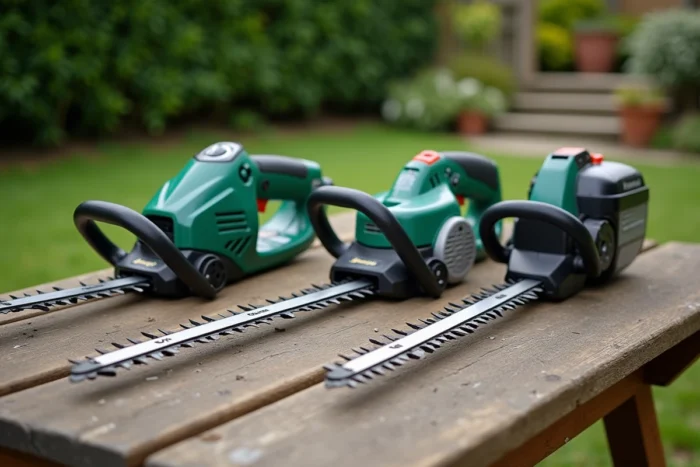
The blade length determines the cutting width in a single pass. A short blade (around 40 cm) is suitable for topiary and small shrubs. A long blade (60 cm and more) speeds up work on a straight hedge of several meters but increases weight and makes the tool less maneuverable in corners.
The tooth spacing determines the maximum diameter of the branches that can be cut. A tight spacing handles this year’s growth on a young hedge. A wider spacing, often associated with gas models, accommodates thicker branches without jamming the blade.
- Young or regularly trimmed hedge (thin shoots): reduced tooth spacing, short to medium blade, corded or battery model sufficient.
- Old and dense hedge (semi-woody branches): wide tooth spacing, medium to long blade, high motor power, gas or 36 V battery model.
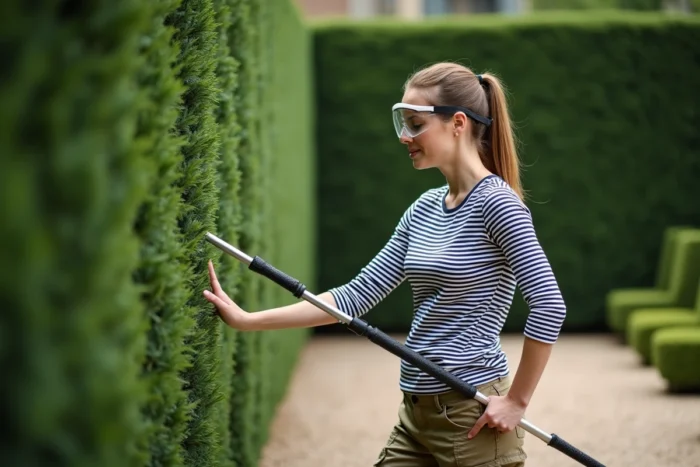
- Tall hedge exceeding two meters: consider a pole hedge trimmer to work without a ladder, ensuring that the weight remains manageable with arms raised.
Many guides focus on motor power. It’s a useful indicator, but an inappropriate tooth spacing limits cutting even before power comes into play.
Weight, posture, and musculoskeletal disorders: the overlooked criterion
A hedge trimmer is held at arm’s length, sometimes for more than an hour. Muscle fatigue and vibrations transmitted to the hands pose a real risk of musculoskeletal disorders, documented in prevention guides for professionals but rarely mentioned for individuals.
Weight alone is not enough to assess comfort. The balance of the device, the presence of an anti-vibration system, and the type of handle (rotating or fixed) significantly alter the sensation of fatigue. A heavier gas model equipped with a pivoting handle and good shock absorption may prove less taxing than a lightweight but poorly balanced battery model.
For tall hedges requiring work with arms raised, pole hedge trimmers relieve shoulder strain. However, their length makes them less precise on the sides and harder to control in light winds. Field feedback varies on this point: some users find them essential beyond two meters in height, while others prefer a classic model with a stable ladder.
Adapting the tool to one’s morphology
A shorter user who regularly works on a tall hedge would benefit from prioritizing a telescopic pole model. Conversely, a tall person working on a low hedge will gain precision with a short and lightweight device. Testing the grip before purchase remains the best prevention.
Noise regulation and trimming periods: what the decrees impose
Gas hedge trimmers produce a noise level significantly higher than electric models. In urban and suburban areas, their use is regulated by prefectural decrees that set authorized time slots, usually limited in the evening, on Sundays, and public holidays. Checking the decree of one’s municipality before purchasing a gas model avoids neighborhood conflicts and fines.
Moreover, the French Office for Biodiversity recommends avoiding any trimming from March 15 to July 31, the nesting period for birds. This recommendation does not constitute a legal prohibition for individuals, but it encourages concentrating trimming in late summer and autumn.
Battery models, being quieter, offer a wider margin for maneuvering on schedules. Some are certified IPX4, allowing work in damp conditions without risk to the device, an advantage when the trimming window is reduced to a few favorable weekends between September and November.
Corded, battery, or gas hedge trimmer: which choice for which garden
The corded model remains the lightest and least expensive. Its limit is physical: the extension cord. Beyond about thirty meters of cable, voltage loss affects performance, and the risk of cutting the cord increases. For a small enclosed garden with an accessible outlet, it is the most rational choice.
The battery model offers freedom of movement without the noise nuisances of gas. Its purchase cost is higher, especially if a second battery is added. The comfort/performance ratio leans in its favor for the majority of private gardens.
The gas model retains an advantage for very long, very dense hedges or in rural areas far from any power source. Its cutting power on large sections remains superior. However, its weight, noise, engine maintenance (oil change, spark plug, filter), and time constraints in populated areas make it an increasingly unsuitable tool for regular domestic use.
Ultimately, the choice of hedge trimmer comes down to three concrete variables: the diameter of the branches to be cut, the distance between the hedge and a power outlet, and the time one is willing to spend with arms raised. Starting from these three data points rather than a catalog of technical specifications allows for quickly eliminating unsuitable models.