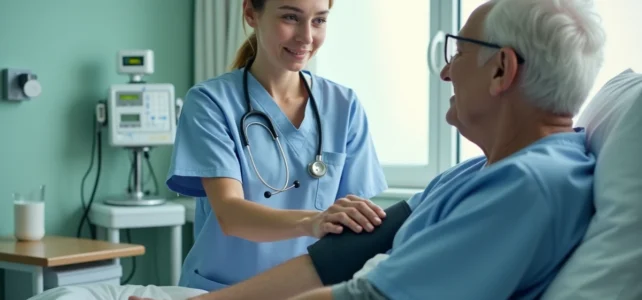
On the ground, the question is already being raised: a nursing assistant in a nursing home must monitor a pressure sore under protocol, record their observations in the care file, and alert the nurse in case of deterioration. Before 2026, this type of task was often subject to organizational ambiguity. With the decree of June 26, 2026, these actions are now formalized within a precise regulatory framework that redefines what the nursing assistant can and must do on a daily basis.
Assigned tasks and delegation: the clinical logic behind the 2026 framework
The starting point is not an abstract list of skills. It is a concrete situation: a patient with reduced autonomy who, if they were able, would perform certain actions themselves (monitoring dressings, taking temperature, assisting with medication prepared by the nurse). The 2026 framework formalizes this reality by relying on the principle of delegation of non-invasive actions.
The nurse, who now has an autonomous nursing diagnosis and targeted prescription rights since law n°2025-581, can assign specific tasks to the nursing assistant under protocol. This refers to a strengthened complementarity between the two professions, not a transfer of medical responsibility. The nursing assistant does not make diagnoses or therapeutic decisions. Any invasive action remains outside their scope.
In practical terms, this logic helps to understand why the new nursing assistant framework 2026 emphasizes clinical assessment and non-invasive monitoring: these are the actions the patient would perform alone if they could, framed by a nursing protocol.
Identification and prevention: concrete actions to master daily
In service, the majority of changes revolve around early detection. The 2026 framework positions the nursing assistant as a key player in daily monitoring and prevention. We are not talking about vague missions. We are talking about identified, traceable, and assessable actions.

The areas of prevention formalized by the texts cover situations that teams are well acquainted with:
- Pressure sore prevention: monitoring pressure points, repositioning according to protocol, transmitting observations to the nurse with a description of the skin condition
- Fall prevention: assessing the patient’s immediate environment, reporting risk factors (wet floor, inappropriate footwear, observed balance issues)
- Identification of malnutrition: monitoring food intake, regular weighing, alerting in case of significant weight loss
- Identification of psychological distress: observing changes in behavior, isolation, refusal of care, and structured transmission to the team
What changes compared to the old framework is the formalization. Previously, these actions were often performed without an explicit regulatory framework. Today, each identification action must be recorded in the care file, which engages the professional responsibility of the nursing assistant and enhances the quality of interprofessional communication.
Contribution to the care file: a change in posture rather than technique
Sometimes it is said that traceability in the care file is an additional administrative burden. On the ground, feedback on this point varies. In well-organized services, this contribution already existed informally. The 2026 framework makes it systematic and mandatory.
The nursing assistant no longer simply communicates orally to the nurse at the end of the shift. They write structured observations: skin condition, dietary behavior, signs of discomfort, patient reactions to hygiene care. This expanded clinical posture transforms the role of the nursing assistant into a documented link in the care chain.
For teams, this implies mastering digital traceability tools. The computerized care file becomes a daily work tool, not a form to fill out at the end of the day. The quality of written transmissions directly affects the relevance of subsequent nursing decisions.
Updating skills for graduates before 2021: what this entails
Not all nursing assistants are affected in the same way. Graduates after June 10, 2021, have already received training incorporating the updated framework. For others, a refresher training is planned by the decree of February 26, 2025.
This is not a return to initial training. We are talking about short modules focused on added or enhanced skills. The continuing education offer has quickly structured around this obligation, with programs covering assigned tasks, traceability, and digital health tools.
Establishments have a direct role in this update. In structures where the nursing management has anticipated, sessions are scheduled during work hours. Elsewhere, it is often up to the nursing assistant to initiate the process through the training plan or the CPF. The reality of access varies greatly from one employer to another.
Coordination between nursing assistant and nurse: a partnership redefined by the texts
The nursing reform of 2025-2026 does not only concern nurses. It redefines the scope of collaboration between nurses and nursing assistants. The nurse now has autonomous consultation and targeted prescription rights. Consequently, the tasks they assign to the nursing assistant fall within a more formalized protocol.
In practice, this means that the nursing assistant must know the precise limits of each assigned task. A hygiene care on damaged skin, for example, does not fall under the same protocol as a standard wash. The boundary between what is assigned and what remains the exclusive responsibility of the nurse must be clear for each situation.
The 2026 framework structures this collaboration around the 11 key competencies and the 5 competency blocks of the program. For teams, the change translates into more frequent, more precise transmissions, and a shared but distinct responsibility for each care action.
Compliance with this new framework is not just about ticking regulatory boxes. It changes the daily posture of the nursing assistant, who shifts from executing tasks to a role of documented clinical assessment. Establishments that integrate this evolution into their work organization, and not just into their training plan, are those where the transition occurs most naturally.