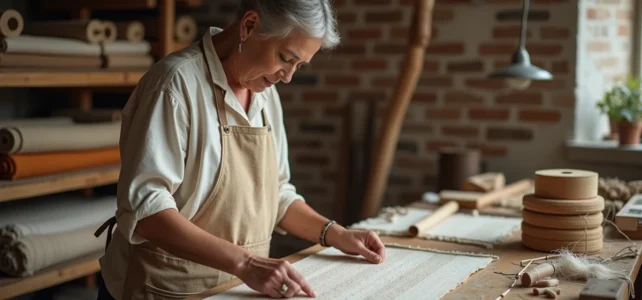
Your cotton t-shirt, the living room curtain, your car’s seatbelt: these three objects have nothing in common, except for their raw material. They are all textiles. The term encompasses a much broader universe than just clothing, and its definition has evolved significantly since antiquity.
Fiber, thread, fabric: understanding the structure of a textile
Before discussing origins or uses, it is essential to grasp what qualifies a material as textile. It all starts with the fiber, a soft and fine strand, of natural or chemical origin. Several twisted fibers together form a thread. This thread, assembled using different techniques, gives rise to a fabric or textile.
There are three main assembly processes. Weaving crosses two sets of perpendicular threads on a loom. Knitting forms interlocking loops. Non-woven, on the other hand, aggregates fibers through pressure, heat, or chemical bonding, without going through the thread stage. The result is always a two-dimensional flexible material made of fibers.
Have you ever noticed that jeans withstand wear better than a curtain sheer? The difference lies as much in the fiber used as in the assembly technique and the density of the weave. It is this combination that determines the durability, flexibility, and feel of the finished product. To delve deeper into the textile definition on Web United, distinguishing between these processes is a good starting point.
Natural fibers and synthetic fibers: what really changes
The choice of fiber conditions almost everything: price, comfort, maintenance, durability. Classifying fibers into two main families helps clarify things.
Natural fibers
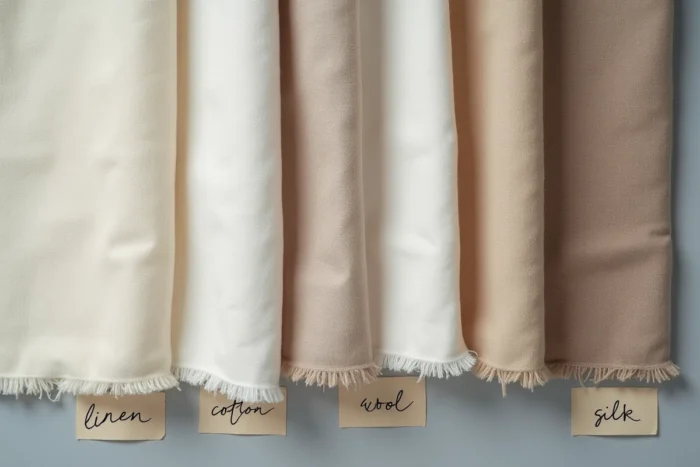
They come from the plant or animal world. Cotton, derived from the cotton boll, remains the most used plant fiber in clothing. Linen and hemp offer good durability and a cool touch. On the animal side, wool (sheep, goat, alpaca) insulates against the cold, while silk, spun by the silkworm, is distinguished by its luster and fineness.
Each natural fiber imposes its own maintenance constraints. Wool shrinks when washed at high temperatures. Linen wrinkles easily. Silk is sensitive to abrasion. Knowing these limits helps avoid ruining a garment after the first wash.
Synthetic fibers
Polyester, nylon, and elastane are made from petrochemical derivatives. Their production allows for precise calibration of thread properties: elasticity, abrasion resistance, quick drying. This is why sportswear almost always contains them.
Blended fabrics combine the two families. A cotton-polyester t-shirt, for example, combines the absorbent comfort of cotton with the shape retention and quick drying of polyester. The composition indicated on the label determines the garment’s behavior in washing and wear.
Uses of textiles beyond clothing
Reducing textiles to clothing would overlook the majority of its production. The textile industry feeds very different sectors, and some uses are surprising.
- Medical textiles: dressings, absorbable sutures, woven vascular prostheses. These products require biocompatible fibers and manufacturing quality controlled to the micron.
- Technical and industrial textiles: filters for wastewater treatment plants, geotextiles laid under roads, automotive airbags, boat sails. Here, mechanical resistance takes precedence over comfort.
- Upholstery textiles: curtains, sofa coverings, household linen. Velvet, for example, derives its softness from a weaving technique that creates a surface of cut upright threads.
- Agrotextiles: mulching tarps, hail nets, forcing covers. Agriculture uses non-wovens to protect crops without resorting to additional chemical treatments.
Technical textiles represent a growing share of global production, driven by the automotive, construction, and medical sectors. This diversity explains why the word “textile” can no longer be limited to the image of sewn fabric.
Textile traceability and digital passport: what European regulation changes
In recent years, the European Union has redefined what a textile must “say” about itself to the consumer. The ESPR regulation (Ecodesign for Sustainable Products Regulation) introduces two measures that transform the industry.
The first is the prohibition of destroying unsold textiles for large companies, set at the European level starting July 19, 2026. In France, the AGEC law has already applied this principle since January 1, 2022. The second is the gradual implementation of a digital passport for textile products, which will make traceability of materials, manufacturing processes, and end-of-life pathways mandatory.
In practical terms, a garment or upholstery fabric will need to carry verifiable information about its origin, exact composition, and recyclability. For the consumer, this means direct access to reliable data, beyond the simple percentage of cotton or polyester displayed on the current label.
Extended producer responsibility and recycling
Textiles also fall within the scope of Extended Producer Responsibility (EPR). Brands that market textile products in the European market finance collection and recycling at the end of life. This obligation pushes manufacturers to rethink design from the outset: choosing recyclable fibers and limiting complex blends that make sorting impossible.
- A 100% cotton fabric is easier to recycle than a cotton-elastane blend.
- Pure synthetic fibers (polyester) can be melted down and re-spun.
- Intimate blends of natural and synthetic fibers remain the main obstacle to mechanical recycling.
The quality of a textile is therefore now measured by its performance in use, but also by its ability to reintegrate into a production cycle after use. This criterion, absent from traditional assessment frameworks, is becoming a deciding factor for both professional buyers and individuals concerned about the sustainability of their purchases.