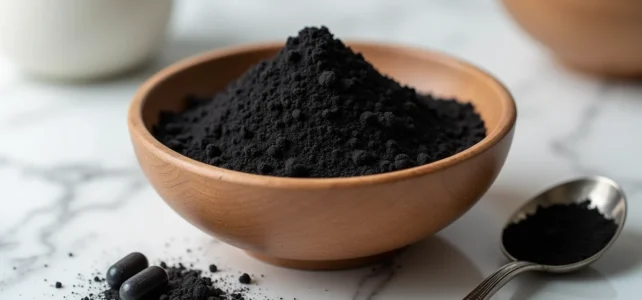
Activated charcoal is a form of carbon treated at high temperatures to multiply its microscopic pores. This structure gives it a strong adsorption ability, meaning it can bind molecules to its surface rather than absorb them into its mass. It is this property that explains its applications in emergency medicine, water filtration, and more recently, in dietary supplements and cosmetics.
Activated charcoal adsorption: a mechanism often misunderstood
The confusion between adsorption and absorption appears in most mainstream content. Adsorption is a surface phenomenon: gas molecules or dissolved substances adhere to the walls of the charcoal’s micropores without penetrating its structure. Therefore, activated charcoal functions as a physical trap, not as a sponge.
This distinction has a direct consequence on what charcoal can and cannot do. It captures what comes into contact with it in the digestive tract, but it does not act on toxins that have already entered the bloodstream. Marketing claims about a “global detox of the body” are based on an extrapolation of this surface mechanism.
To better understand the benefits and dangers of activated charcoal, it is essential to keep this principle in mind: its action is limited to the contents of the digestive system at the time of ingestion.
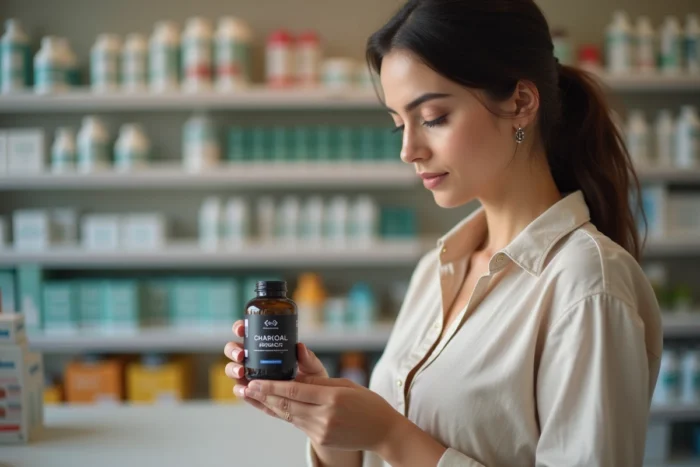
Activated charcoal and flatulence: the only well-supported claim
Among all the virtues attributed to activated charcoal, the reduction of excess intestinal gas after meals remains the best-documented claim. Other promises (flat stomach, detoxification, weight loss) are more about commercial positioning than demonstrated effects.
The mechanism is consistent with the principle of adsorption: charcoal binds some of the gases produced by bacterial fermentation in the colon. People prone to post-meal bloating may find temporary relief from it.
Timing of intake for gas
The timing of intake affects effectiveness. To achieve an effect on flatulence, charcoal should be taken before and after meals, not at a random time during the day. A single dose taken several hours apart will have only a marginal effect since gases form during digestion.
This practical point is rarely detailed on packaging. The current market trend of combining activated charcoal, probiotics, and digestive enzymes in “daily comfort” formulas further obscures the reading: the effect attributed to charcoal in these mixtures becomes impossible to isolate.
Concrete health risks of activated charcoal
The side effects of activated charcoal are generally mild, but they deserve to be known before any regular use.
- Black stools: a systematic and harmless effect, but it can mask a real digestive bleed if the person is unaware that charcoal is the cause.
- Mild constipation: charcoal can slow transit in some people, especially with prolonged use or high doses.
- Drug interaction: charcoal also adsorbs the active ingredients of orally taken medications. An interval of at least two hours between taking charcoal and any treatment should be respected.
This last point represents the most serious risk. A woman on oral contraceptives, a patient on anticoagulants, or someone on heart medication who takes activated charcoal at the same time may see the effectiveness of their medication significantly reduced. The two-hour spacing with any medication is not an optional recommendation.
Activated charcoal and “detox”: a promise without a mechanism
Detox cures based on charcoal have multiplied in recent years, often associated with promises of liver cleansing or heavy metal elimination. Activated charcoal has no demonstrated action on the liver or on substances already absorbed by the body.
Its recognized medical use in cases of acute poisoning relies on very rapid intake after ingestion of the toxin, under medical supervision, at doses much higher than those of dietary supplements. Transposing this emergency situation to a “preventive” daily use has no physiological basis.
Activated charcoal in cosmetics: what the skin can expect
The other major application area for activated charcoal concerns facial care, particularly purifying masks and cleansers for oily or blackhead-prone skin. The principle is always based on adsorption: charcoal, applied to the surface, binds sebum and impurities lodged in the pores.
The effect is mechanical and temporary. An activated charcoal mask provides an immediate visible result (smoother skin, visually tightened pores) but does not alter sebum production in the long term. For sensitive skin, the granularity of certain charcoal powders can cause micro-irritations if the product is rubbed too vigorously.
Formulations vary widely from one brand to another. A mask containing a low proportion of activated charcoal drowned in silicones or film-forming agents will not have the same action as a pure powder mixed with water. Reading the ingredient list remains the only way to distinguish a truly active product from a label claim.
Choosing quality activated charcoal: technical criteria
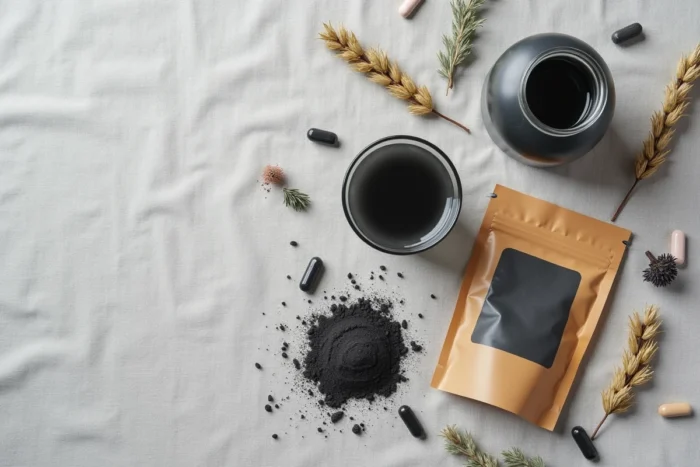
Not all activated charcoals are created equal. The raw material (wood, coconut shells, bamboo) and the activation process (thermal or chemical) influence the size and distribution of pores, thus affecting adsorption capacity.
- Charcoal from coconut shells is often cited for its high microporosity, suitable for capturing small gaseous molecules.
- Thermally activated charcoal (without chemical agents) is preferable for food use.
- The capsule form allows for more consistent dosing than loose powder, but powder remains useful in cosmetics or for home filtration.
A food-grade activated charcoal must clearly indicate its raw material, activation process, and absence of contaminants. The lack of this information on the packaging is a more reliable warning signal than any self-proclaimed label.
Activated charcoal remains a targeted tool whose effectiveness relies on specific use and precise timing. Expecting more from it, whether a permanent detox or an anti-aging treatment, ignores the only property that makes it truly useful: its ability to bind what passes over its surface, nothing more.